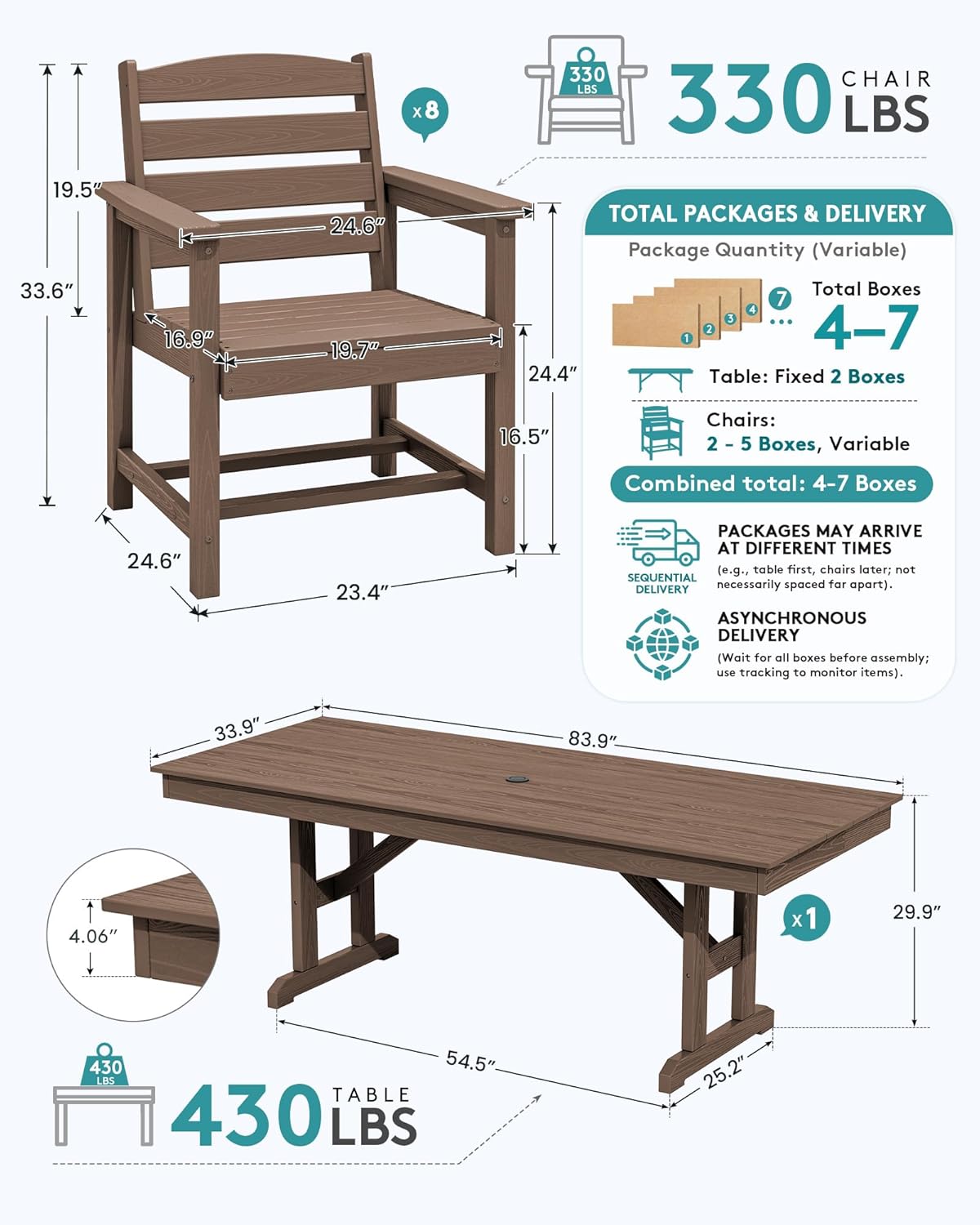
A 9-piece patio dining set is the outdoor furniture term for a table plus eight matching chairs sold as one coordinated package. At full scale — typically a 96-to-110-inch-long table — this is the largest footprint most residential patios ever attempt. Get the sizing right and you’ll host every summer gathering for the next decade without a second thought. Get it wrong and you’ll spend those same years squeezing past chair backs every time you want a refill. This guide walks you through the actual square footage math, explains the four main frame materials in plain language, and gives you a clear decision rule at the end so you can stop second-guessing and start ordering.
The Sizing Math: How Much Patio Do You Actually Need?
This is where most buyers stumble, and it’s almost always the same mistake: they measure the table and forget about the chairs. A chair that’s occupied by a real human being extends roughly 18–20 inches behind the chair’s back legs when someone is seated normally. Add another 18 inches of clearance behind that person so someone can walk past without doing a sideways shuffle. That’s a 36-to-38-inch buffer zone on every side of the table where people are seated.
Here’s the working math for a standard 9-piece set:
By the numbers
- Table footprint (typical): 42 in. wide × 96–110 in. long
- Add chair + walkway buffer: 36 in. per seated side minimum
- Minimum patio width needed: 42 + 36 + 36 = 114 inches (9.5 ft)
- Minimum patio length needed: 108 + 36 + 36 = 180 inches (15 ft)
- Recommended patio area: at least 14 ft × 17 ft (238 sq ft)
Per This Old House’s outdoor furniture buying guide, the most common regret they hear about is under-estimating the chair clearance, especially on rectangular patios where hosts tend to focus on the table’s long dimension and ignore the short one. If your patio falls between 12 and 14 feet wide, a 9-piece set will work only if one end of the table is against a wall or railing — which limits seating to six on the sides plus one on the open end.
Oval vs. Rectangular Tables An oval table of the same nominal length as a rectangle recovers roughly 8–12 inches of usable aisle space at the ends because the ends taper. If your patio is tight on length but adequate on width, an oval 9-piece set is often the smarter geometry, not just a style preference. Architectural Digest’s roundup of outdoor dining sets consistently notes that oval tables outperform rectangles in sub-250-square-foot patio spaces precisely for this reason.
Extension Tables Several mid-range and premium 9-piece sets include an extension leaf, letting the table compress to seat 6 when the full 8 isn’t needed. The trade-off: extension mechanisms on outdoor tables are exposed to weather. Aluminum-based extension hardware holds up better than steel hardware over time, and buyers across aggregated reviews consistently flag corroded or jammed extension slides as the most common failure point in sets under $800.
Material Trade-Offs: The Four Frames at Full Scale
Scale amplifies everything. A wicker chair that feels fine at a 4-person bistro set can feel flimsy at a 9-piece dining table simply because the mass of the surrounding set raises expectations. Here’s how the four main frame materials perform at the 9-piece scale specifically — not just in general.
Powder-Coated Aluminum
Powder-coated aluminum (a frame built from aluminum tubing or casting, then finished with a dry-powder paint baked on under heat) is currently the dominant material in the $600–$1,800 9-piece segment, and for good reason at this size: a full 9-piece aluminum set typically weighs 30–40% less than the equivalent in cast iron or solid teak. That matters when you’re moving eight chairs to vacuum the patio or storing pieces for a storm.
The quality signal to know: powder-coat is rated in stages, and most reputable manufacturers will specify a three-stage or five-stage process. A five-stage powder coat involves a phosphate wash, a rinse, a chemical conversion coat, a second rinse, and then the powder application. Consumer Reports’ outdoor furniture buying guide notes that five-stage processes produce substantially better adhesion and corrosion resistance than single-stage sprays. If a manufacturer won’t specify the number of stages, treat it as a single-stage product regardless of the marketing language.
At full 9-piece scale, look for wall thickness of at least 1.2 mm on tubular frames. Thinner aluminum telegraphs flex in chair backs when someone leans back hard — a common complaint in owner reviews of sets under $500.
Teak
Teak is a tropical hardwood with a naturally high oil content that makes it genuinely weather-resistant without any finish applied. At 9-piece scale, a solid teak set typically runs $1,800–$3,500+, and that price spread often reflects grade differences that aren’t obvious from photos.
Gardenista’s field guide to teak outdoor furniture explains the two grades most buyers encounter: Grade A teak is cut from the heartwood (the dense, oil-rich center of the tree), and Grade B or C teak contains more sapwood (the outer ring), which is lighter in color, less oily, and noticeably less resistant to weathering. If a teak set is priced under $1,500 for 9 pieces, the wood is almost certainly not Grade A heartwood.
The FSC (Forest Stewardship Council) certification mark matters here beyond the ethical dimension: FSC-certified teak is typically harvested from managed plantations that maintain consistent quality standards, whereas uncertified sources vary widely in grade and drying protocols. Per the FSC’s published certification standards, certified suppliers must document chain-of-custody at each processing stage, which gives buyers more traceability on what they’re actually getting.
Teak ages to a silver-gray if left untreated — a look many owners prefer. It can be oiled annually to maintain the original warm honey tone. Owner reviews consistently note that the oiling commitment is minimal (once a year, one afternoon) but that skipping it for two or more consecutive years makes color restoration substantially more effort.
HDPE Wicker (All-Weather Wicker)
HDPE stands for high-density polyethylene, a plastic resin that’s woven around an aluminum frame to mimic the look of traditional rattan wicker. The “all-weather” label is meaningful here: genuine HDPE wicker won’t crack or fade from UV the way natural rattan does. The quality variable is the resin type — round-strand HDPE holds up better than flat-weave in freeze-thaw climates because it has less surface area to collect and expand water.
At the 9-piece scale, HDPE wicker sets in the $700–$1,400 range are popular for screened porches and covered patios. Owners in sunbelt climates report excellent multi-year performance with minimal maintenance. Owners in northern climates (Chicago, Minneapolis, coastal New England) consistently note that the aluminum frame can develop surface rust at connector points after four or five years if the protective end caps are damaged or missing. The wicker itself outlasts the frame hardware in these climates.
Cushion fabric matters as much as the frame at this price point. Sunbrella, whose care and cleaning guide is widely referenced by furniture retailers, produces solution-dyed acrylic fabric rated to resist UV fade and mildew. Sets that include Sunbrella or Sunbrella-grade cushions (any fabric with a 5-year fade warranty is broadly equivalent) are worth the $100–$200 price premium over sets with basic polyester fills, especially at the 9-piece scale where replacing all eight chair cushions at once is a meaningful cost.
Cast Iron
Cast iron has largely ceded the 9-piece dining segment to aluminum because the weight penalty at full scale is severe — a cast iron 9-piece set can exceed 400 pounds assembled. It remains popular in the bar-height bistro segment (smaller tables, fewer chairs) and in decorative accent settings, but for large outdoor dining, it’s a niche choice. The main reason to consider it: cast iron is genuinely indestructible from a structural standpoint. Owners in reviews consistently describe 20-to-30-year sets still in daily use. If you have a covered patio, don’t need to move furniture seasonally, and want a set that outlasts everything else on this list, cast iron earns its place. Just plan on professional delivery and in-place setup.
Climate Matching: The Decision Most Buyers Skip
Generic “weather-resistant” language is nearly meaningless — it usually means the product has been tested against 500 hours of UV exposure in a controlled chamber, which doesn’t simulate two Minnesota winters or a Florida hurricane season.
A more useful climate frame:
- High UV / low humidity (Arizona, New Mexico, Southern California): Powder-coated aluminum and HDPE wicker are the best material match. Teak weathers beautifully here but will gray fast without oiling. Cast iron is viable if stored during peak summer heat.
- High humidity / moderate freeze (Southeast, Gulf Coast, Pacific Northwest): Teak and five-stage aluminum are the top performers. HDPE wicker holds up well; watch the frame connectors. Cast iron requires diligent rust treatment.
- Freeze-thaw cycles (Midwest, Northeast, Mountain West): Five-stage powder-coated aluminum is the workhorse choice. Teak survives well with moderate care. HDPE wicker degrades faster at the frame connections; budget for a cover. Cast iron is the maintenance-heaviest option here.
The True 5-Year Cost: Don’t Buy on Sticker Price Alone
A $900 HDPE wicker 9-piece set that needs new cushions at year two ($200–$350 for Sunbrella-grade replacements for 8 chairs) and a frame touch-up at year four costs more over five years than a $1,400 powder-coated aluminum set with a five-stage finish and included Sunbrella cushions. This math is consistent across owner forums and review aggregates covering the 2022–2025 buying cycle.
Rough 5-year total cost of ownership benchmarks, based on aggregated owner reports and published cushion replacement pricing as of mid-2026:
| Material | Sticker (9-piece) | Cushion replacement | Cover/storage | 5-yr estimate |
|---|---|---|---|---|
| Budget HDPE wicker | $700–$900 | $200–$350 | $80–$120 | $980–$1,370 |
| Five-stage aluminum | $1,100–$1,800 | $150–$250 | $80–$120 | $1,330–$2,170 |
| Grade A teak | $1,800–$3,500 | $150–$300 | $100–$150 | $2,050–$3,950 |
| Cast iron | $1,200–$2,000 | $150–$300 | $100–$150 | $1,450–$2,450 |
The Decision Rule
If you’ve read this far and you’re still under LOI on a set, here’s the clean if/then frame:
- If your patio is under 14 ft × 17 ft: Measure twice with chairs extended before you order anything. An oval table buys you room. A 7-piece set (table + 6) may be the honest answer.
- If your climate includes hard freezes: Five-stage powder-coated aluminum is the low-maintenance right answer for most budgets. Teak is the splurge that pays off. Cast iron stays only if the set never moves.
- If your climate is high-UV / low-humidity: HDPE wicker and aluminum are both strong. Teak grays faster here but holds structurally — budget for annual oiling or embrace the silver patina.
- If you’re in the $900–$1,200 range: Put your dollars into frame quality (wall thickness, powder-coat stages) over extra cushion upgrades. You can upgrade cushions later; you can’t upgrade the frame.
- If you’re spending $1,500+: Grade A FSC-certified teak or a premium five-stage aluminum set from a brand that publishes its finish specs are both defensible long-term purchases. The difference is weight, maintenance preference, and aesthetic — not durability.
The one universal rule: buy the cover at the same time you buy the set. Every material on this list ages faster uncovered, and a set-specific cover is always cheaper before you order than after.