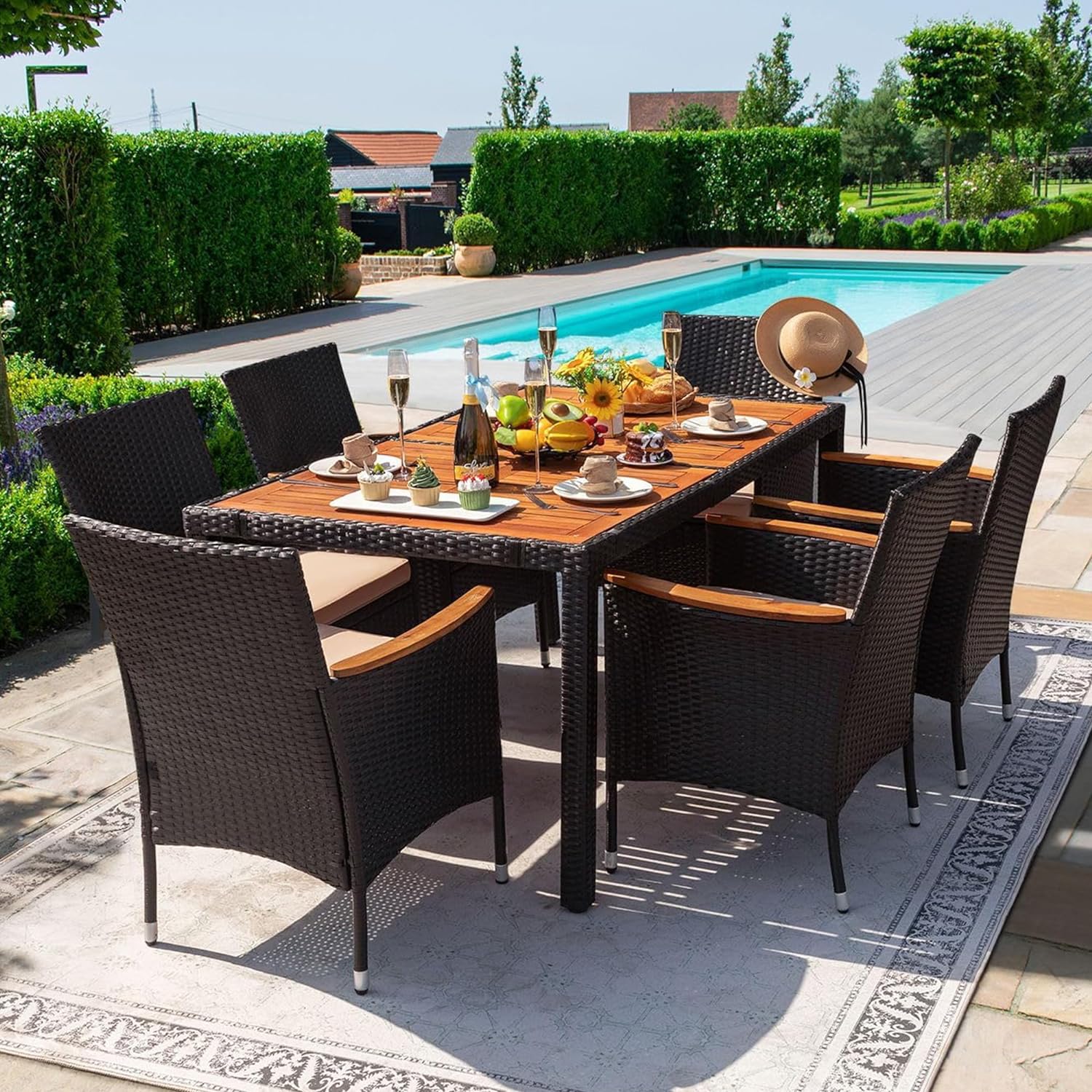
Acacia Wood Patio Dining Sets: The Honest Trade-Off Between Teak’s Look and Half the Price
Walk into any outdoor furniture showroom — or scroll through any big-box retailer’s patio section — and you’ll see two price tiers for natural wood dining sets. The expensive tier is teak (a dense tropical hardwood prized for its natural oils that resist water and rot without much maintenance). The mid-range tier is often acacia (another tropical hardwood, harvested from fast-growing trees found across Africa, Asia, and Australia). Acacia sets look nearly identical to teak on the showroom floor. They photograph beautifully. And they cost roughly 40–60% less. If you’re standing there with a tape measure and a budget, the question is obvious: what are you actually giving up?
This article answers that question with real numbers and honest trade-offs. You’ll walk away knowing whether acacia belongs on your deck, which climate situations make it a smart buy versus a costly mistake, and what the five-year cost of ownership actually looks like — not just the sticker price.
What Acacia Actually Is (and Why It’s Not All Created Equal)
Acacia is a genus of over 1,300 tree species, which is the first thing that makes “acacia furniture” a frustratingly broad category. The acacia used in patio furniture is typically Acacia mangium or Acacia auriculiformis, both fast-growing plantation species common in Indonesia, Vietnam, and India. This fast growth is why acacia is cheaper than teak: a teak tree takes 40–60 years to reach harvestable size; acacia matures in 7–10 years.
The practical consequences of that difference show up in the wood’s cellular structure. Teak develops high concentrations of natural silica and teak oils over decades — those are what give it its legendary rot resistance and dimensional stability (meaning it doesn’t expand, contract, or warp much with changes in humidity). Acacia has moderate natural oils and a Janka hardness rating (a standardized measure of how resistant wood is to denting and surface wear) of roughly 1,700 lbf, compared to teak’s approximately 1,070–1,155 lbf.
Wait — acacia is harder than teak? Yes. Hardness and weather resistance are not the same thing. Acacia’s density makes it durable against physical impact, but its lower oil content means it’s more vulnerable to the real enemy of outdoor wood: moisture cycling. Repeated wet-dry cycles cause wood fibers to expand and contract, eventually leading to checking (surface cracks), warping, and joint failure. This Old House’s outdoor wood comparison guide notes that woods with lower natural oil content require more frequent maintenance to achieve comparable longevity in wet climates.
The grain pattern variable: High-quality acacia (often called “solid acacia” or “premium plantation acacia”) has a tight, attractive grain that genuinely resembles teak. Lower-quality product mixes in edge-glued panels and finger-jointed sections that hold moisture differently than solid cuts — and those joints are where you’ll see premature checking. If you’re buying at the $400–$800 range, inspect (or ask the seller specifically) whether the tabletop is solid or edge-glued. Both can be fine; edge-glued panels aren’t inherently bad, but they need more diligent sealing at those seam lines.
The Five-Year Cost of Ownership: Running the Real Math
Here’s where the cheap-looks-expensive conversation gets honest.
By the numbers:
| Acacia Dining Set (6-person) | Teak Dining Set (6-person) | |
|---|---|---|
| Avg. sticker price (2026 market) | $650–$1,100 | $1,400–$2,600 |
| Recommended annual oiling | 2x/year | 1x/year |
| Quality teak/hardwood oil, per application | ~$30–$45 | ~$30–$45 |
| Furniture cover (quality waterproof) | $80–$120 | $80–$120 |
| Expected lifespan, humid climates (maintained) | 5–8 years | 15–25 years |
| Expected lifespan, arid climates (maintained) | 8–12 years | 20–30 years |
Run five years of consistent maintenance on an acacia set in a humid Southeast or Pacific Northwest climate: you’re looking at roughly $300–$450 in oil and covers on top of a $750 average purchase price, for a total around $1,050–$1,200. A well-maintained teak set in the same period costs more upfront but requires less oil — and it’s still got 10–20 years of life ahead of it when your acacia set is showing joint stress.
The acacia math wins in two specific scenarios:
- You move or redesign frequently. If you’re refreshing your patio every five to seven years anyway, or if you’re furnishing a rental property where moderate-quality presentation matters more than longevity, buying at the lower price point and cycling out makes financial sense.
- You live in a dry, mild climate. Reviewers in low-humidity climates (Arizona, New Mexico, inland California) consistently report acacia sets lasting well past eight years with basic maintenance — approaching the point where the total-ownership math starts to favor acacia even against teak.
Gardenista’s guide to teak and outdoor hardwoods makes the same climate-dependent observation: the gap between teak and alternatives like acacia narrows significantly in regions with low annual rainfall and stable humidity.
Maintenance Reality: What “Oiling Twice a Year” Actually Means
Apartment Therapy’s outdoor wood furniture care overview frames it well: outdoor wood furniture maintenance isn’t hard, but it’s unforgiving if you skip it. Here’s what the acacia maintenance schedule actually looks like in practice.
Year one: Clean with a mild wood cleaner and light sanding (220-grit is standard) before the first application. Apply a penetrating hardwood oil — teak oil, linseed-based oil, or a product specifically formulated for high-density hardwoods. Do this in spring before heavy use and again in late summer or early fall before the rainy season.
Year two and beyond: Same rhythm. If you let a full year go without oiling and the wood has already started to grey and dry-check, you’re doing remediation work, not maintenance — that means a more aggressive sanding and potentially a tinted oil to even out the color. It’s recoverable, but it’s an afternoon of labor versus a half-hour if you stayed on schedule.
What graying means: Acacia (like teak) will silver-grey naturally if left untreated. This is UV-driven and not structurally harmful in the short term, but it’s a leading indicator that the wood’s surface moisture barrier is gone. Graying on acacia moves faster than on teak because there’s less oil in the wood to begin with. Architectural Digest’s outdoor dining set coverage consistently notes that buyers who skip the oiling schedule report visible deterioration in acacia sets within two to three seasons — the same neglect that a teak set might absorb with only cosmetic consequences.
Cover discipline matters more with acacia: A quality waterproof cover (breathable — look for covers rated for outdoor use rather than plain polyester tarps, which trap condensation) adds meaningfully to acacia’s lifespan. In rainy climates, covering during extended wet periods is the single highest-leverage thing you can do. For teak, covering is good practice; for acacia, it’s closer to non-negotiable.
What to Look For When Buying: The Quality Signals That Matter
Most acacia sets at the $500–$1,000 price point look identical at a glance. Here are the markers that separate five-year furniture from two-year furniture.
FSC certification: The Forest Stewardship Council certifies that wood is sourced from responsibly managed forests. This is worth caring about for two reasons: ethical sourcing is straightforward, but FSC-certified plantation acacia also tends to be more consistently harvested and processed than commodity-grade product. Per the FSC’s certification standards documentation, certified supply chains include chain-of-custody tracking that typically correlates with better milling and drying practices — which matters for dimensional stability. Look for the FSC logo or ask the retailer directly.
Mortise-and-tenon joinery vs. bolt-and-dowel: Premium acacia sets use traditional mortise-and-tenon joints (where a tab of wood fits into a matching slot) at the chair legs and table apron. This joint distributes stress mechanically across wood-to-wood contact. Budget sets use metal bolts or dowels with wood glue — fine initially, but those joints are the first failure point as wood cycles through moisture seasons. This is visible on chairs if you look at where the back legs meet the seat rail.
Thickness matters at the tabletop: A 1.5-inch tabletop on a 60-inch dining table will flex noticeably with temperature changes; a 1.75-inch to 2-inch top won’t. Reviewers across aggregated feedback consistently identify tabletop thickness as the feature they wish they’d checked before buying — thin tops in mid-range acacia sets develop a slight bow over time that’s permanent once set.
Finish type: Oil-finished acacia (factory-applied penetrating oil) is what you want — it absorbs into the wood rather than sitting on top. Lacquer or varnish finishes look beautiful in the store and initially resist water, but once they chip (and they will chip outdoors), moisture gets under the coating and you have a delamination problem that’s difficult to reverse without stripping the whole piece.
The Decision Rule: If X, Then Y
This is where the practitioner frame earns its keep. After looking at the specs, the climate data, and the ownership math, here’s the clean decision tree:
If you live in a high-humidity or high-rainfall climate (Southeast, Pacific Northwest, coastal areas) AND you plan to keep this set for more than seven years: Spend the extra money on teak. The five-year math is close; the ten-year math isn’t. Acacia in those conditions requires religious maintenance discipline to hit its upper lifespan range, and most buyers don’t maintain that rhythm.
If you live in a dry or mild climate (Southwest, inland West, mild mid-Atlantic) AND you’re a consistent maintainer: Acacia is a legitimate value buy. The weather does less damage between oil applications, and reviewers in these climates report multi-decade performance from well-maintained acacia — which makes the lower price genuinely advantageous.
If your planning horizon is five to seven years or less (you move, you redesign, you’re furnishing a rental): Acacia is the right call at almost any climate. Get a quality set in the $600–$900 range, maintain it reasonably, and you’ll have a beautiful patio for your ownership window without overpaying for longevity you won’t use.
If you’re comparing acacia to teak and the price difference is less than $300: Buy the teak. At narrow price spreads, the acacia value case evaporates — you’re not saving enough to offset the maintenance difference over time.
Acacia is not a compromise product. It’s a specific-use product that rewards buyers who understand what they’re buying. Know your climate, know your timeline, oil it twice a year, cover it during hard weather — and it will earn its place on your deck.