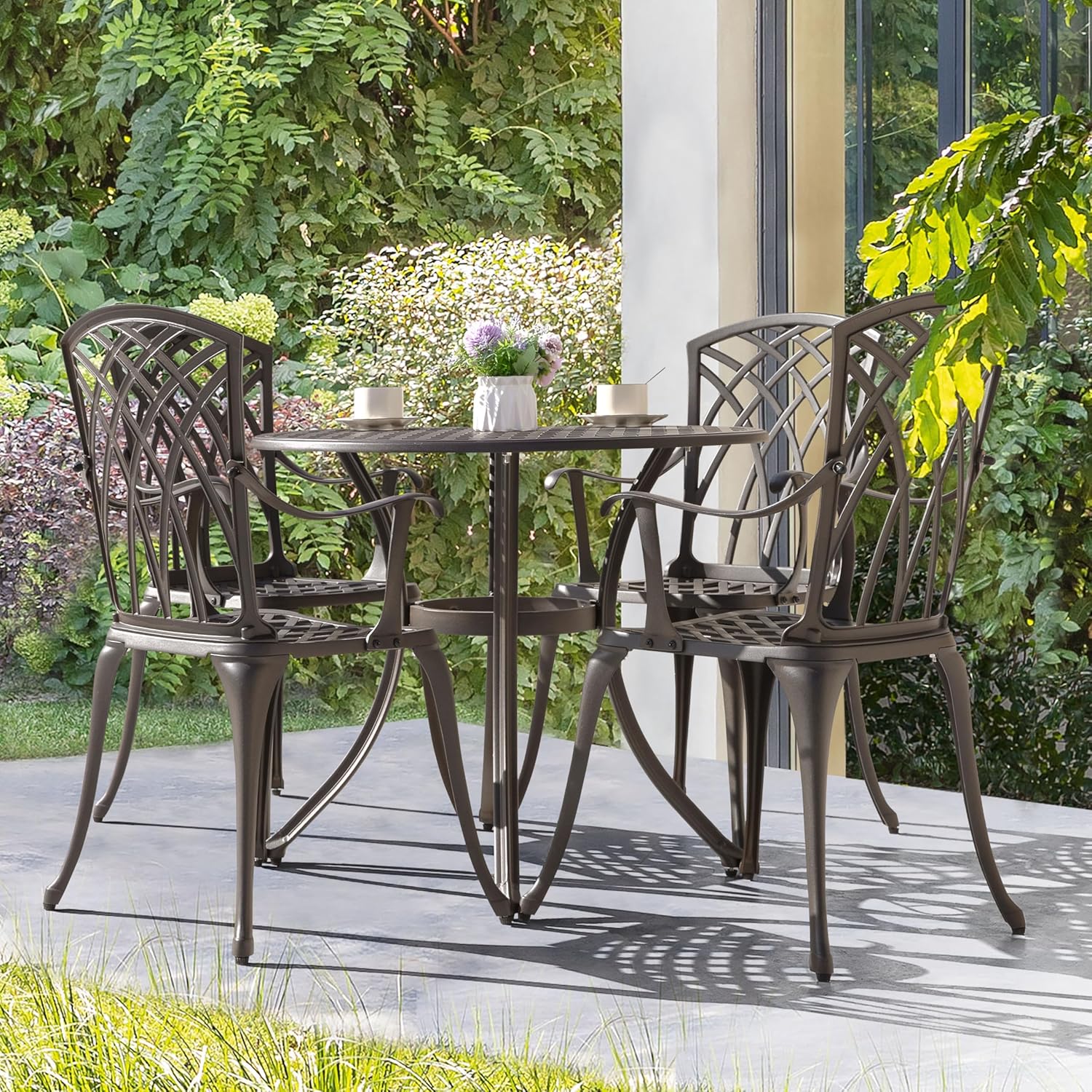
You’re standing in a Home Depot aisle — or more likely, scrolling a product page at midnight — looking at two cast aluminum patio dining sets. One is $649. One is $1,299. Both say “rust-proof,” both have the same scrollwork pattern on the chairs, and neither listing tells you why one costs twice as much. Cast aluminum, for anyone just landing here, is a material made by pouring molten aluminum into a mold. Unlike welded tubular aluminum (the skinny, lightweight stuff), cast pieces are thicker, heavier, and shaped in one pour — which is why they hold ornate detail and don’t flex the way hollow frames do. It’s a genuinely durable material when made well. The problem is that “made well” covers an enormous range, and most of what separates a set that looks great at year seven from one that’s flaking and wobbling at year three is invisible in the product photos. This guide is about making those quality markers visible before you commit.
| EDITOR'S PICK[Christopher Knight Home Cayman…](https://www.amazon.com/dp/B01D90SFFY?tag=greenflower20-20) | Mid-tier[HAPPATIO Aluminum 9 Piece Patio…](https://www.amazon.com/dp/B0BRKVLVSM?tag=greenflower20-20) | Budget pick[NUU GARDEN 5 Piece Patio Dining…](https://www.amazon.com/dp/B0CZKZQPF2?tag=greenflower20-20) | |
|---|---|---|---|
| Seats | 6 | 8 | 4 |
| Pieces | 7 | 9 | 5 |
| Umbrella hole | — | — | 1.97" |
| Chair type | — | Fixed | — |
| Color | Black Sand | Gray | Brown with Gold |
| Price | $1,319.96 | $1,139.99 | $375.99 |
| See on Amazon → | See on Amazon → | See on Amazon → |
Why Cast Aluminum Fails — and How to Tell Before It Does
The most common failure modes for cast aluminum sets aren’t structural. Aluminum itself doesn’t rust. What fails is the finish — specifically the powder coat, which is the baked-on paint layer that gives the furniture its color and protects the metal from oxidation, UV, and surface pitting.
Powder coating works like this: aluminum parts are electrostatically charged, dry powder is sprayed on, and then the whole piece goes into an oven to cure. A single-stage powder coat (one layer, cured once) is what you’ll find on most entry-level sets. A two-stage or “dual-coat” process adds a primer layer before the topcoat, and some premium manufacturers add a third finishing layer or a UV-inhibiting clear topcoat on top of the color coat.
The industry standard framework for evaluating powder coat durability comes from the American Architectural Manufacturers Association (AAMA), which publishes performance specifications under document numbers AAMA 2604 and AAMA 2605. Per those AAMA standards documents:
- AAMA 2604 coating systems must retain at least 50% gloss after 5 years of Florida weather exposure (Florida testing is the outdoor-furniture industry’s benchmark for UV and humidity stress).
- AAMA 2605 systems must retain at least 50% gloss after 10 years of the same exposure, with tighter restrictions on chalking and color fade.
Most furniture listings won’t tell you which standard their coating meets. But if a manufacturer says “AAMA 2605-rated finish” anywhere in their spec sheet or product copy, that’s a genuine quality signal — that standard is expensive to achieve and certify. If the listing just says “powder-coated” with no further detail, assume single-stage entry-level unless you can confirm otherwise.
What to look for in product listings:
- Mention of two-stage or three-stage powder coat
- Any reference to AAMA 2604 or 2605
- “Electrostatically applied” plus a cure temperature (usually 400°F / 204°C) — this is manufacturers showing their process, not hiding it
- Thickness spec on the powder coat layer (1.5–2.5 mils is entry; 3–4 mils starts getting into architectural-grade territory)
If you don’t see any of these, you’re not necessarily buying bad furniture — but you’re buying on faith.
Wall Thickness and Weight: The Numbers That Don’t Lie
Cast aluminum furniture is sold by the visual impression of solidity, but the actual weight per chair or per table top is one of the more honest proxies for material quality. Thicker walls mean more aluminum was used, which costs more, and also means the piece is less likely to crack at stress points — the legs, the joint where a chair arm meets the back, the table apron corners.
By the numbers:
| Quality tier | Typical chair weight | Wall thickness (approx.) | Expected finish life |
|---|---|---|---|
| Entry-level | 8–12 lbs | 3–4 mm | 3–5 years |
| Mid-range | 13–18 lbs | 4–6 mm | 5–8 years |
| Premium | 19–25 lbs | 6–8 mm | 8–12+ years |
These aren’t official standards — they’re patterns that show up consistently across manufacturer spec sheets and owner reviews once you start comparing systematically. Architectural Digest’s outdoor dining set editorial notes that premium cast aluminum chairs in the $200-per-chair range typically run 18–22 pounds, which is roughly what you’d expect from the thickness numbers above.
Apartment Therapy’s outdoor furniture buying guide makes a useful point that’s easy to overlook: weight consistency across a set matters as much as absolute weight. If the chairs in a six-piece set vary by more than two pounds each, that’s a signal of inconsistent casting quality — some chairs got better pours than others.
When you’re looking at a listing, weight is usually in the spec table. If it’s missing, that’s worth noting. Manufacturers who are proud of their material thickness include it; those who aren’t tend to omit it.
Joint Construction and the Hardware Question
Even the best casting can be undermined by bad assembly hardware. Cast aluminum furniture typically uses one of three joint strategies:
Cast-in joints: The connective points are part of the mold itself — no separate hardware at the stress junction. This is the premium approach. You’ll see it described as “fully cast construction” or “seamless joint design.”
Bolted joints with stainless hardware: Separate cast sections joined with 304-grade or 316-grade stainless steel bolts. 304 is standard and fine in most climates. 316 (sometimes called “marine grade”) adds molybdenum for better chloride resistance — worth paying for if you’re within a mile of saltwater. The bolt grade should be visible on the spec sheet or available on request from the manufacturer.
Bolted joints with zinc-plated or galvanized hardware: This is where budget sets often cut costs. Zinc plating holds up reasonably well in dry climates but can show corrosion within two to four seasons in humid or coastal environments. Gardenista’s comparison of cast aluminum and wrought iron outdoor furniture specifically flags zinc-plated fasteners as the most common source of visible rust on nominally “rust-proof” aluminum sets.
You cannot see the bolt material in product photos. You can ask the manufacturer directly (most will answer via chat or email), or look for mention of “stainless hardware” or “marine-grade fasteners” in the product description. If neither is mentioned and the price is under $800 for a six-piece set, assume zinc-plated unless proven otherwise.
Climate Matching: Where Cast Aluminum Actually Shines (and Where It Struggles)
Cast aluminum is genuinely one of the most climate-versatile patio materials — lighter than cast iron, more rigid than extruded aluminum tube, and immune to the core failure mode of wood (moisture expansion and rot). But “immune to rust” doesn’t mean the same thing in Phoenix as it does in coastal Florida.
Dry climates (Southwest, Mountain West): Cast aluminum performs well here across all quality tiers. UV is the primary threat, and even single-stage powder coat can last five-plus years in low-humidity environments. This is one of the few situations where the entry-level pick may genuinely be the right one — you’re not paying for corrosion protection you won’t need.
Humid, non-coastal climates (Southeast, Midwest summers, Pacific Northwest): Moisture cycling (wet/dry, warm/cold) stresses the powder coat more than static humidity. Two-stage finish minimum is worth the upgrade here. Stainless fasteners become more important. This Old House’s outdoor furniture materials guide recommends checking for any crevice in the casting design that could trap standing water — a design flaw that accelerates finish failure from the inside.
Coastal and high-salt environments: This is where cast aluminum separates from cheaper alternatives most clearly — it won’t rust structurally — but the finish and fasteners still need to be spec’d for the environment. AAMA 2605 coating, 316-grade stainless hardware, and a design with drainage channels rather than flat surfaces is the combination worth targeting. Consumer Reports’ outdoor furniture buying guide recommends rinsing salt-exposed metal furniture every two to four weeks during peak season regardless of material.
Freeze-thaw climates (Northern US, higher elevations): Aluminum itself handles freeze-thaw well. The vulnerability is any moisture that’s penetrated a compromised finish sitting in a casting crevice and expanding during a freeze. Annual inspection of the finish — looking for any chalking, bubbling, or micro-crack near joints — is the maintenance habit that extends set life in these climates.
The True Cost Decision Frame
Here’s where a lot of buyers miscalculate: they compare sticker prices without accounting for the full five-year ownership cost, which for any patio dining set includes cushion replacement, cover investment, and potential refinishing.
Cast aluminum with a two-stage finish typically doesn’t need refinishing in a normal climate within the first seven to ten years. Entry-level single-stage finish may start chalking or crazing at four to five years, at which point you’re either living with the look or paying for powder-coat re-spray (typically $75–$150 per chair at an auto-body shop that does metal furniture, as of mid-2026 market rates).
Cushion replacement for a six-chair set using Sunbrella-grade fabric (which Sunbrella’s own care documentation rates for 500+ hours of direct UV before significant fade) runs $400–$800 for quality replacements. Entry-level cushions in a humid climate may need replacement every two to three years at $150–$250 per set — which closes the gap with the Sunbrella investment faster than most buyers expect.
The decision rules, plainly stated:
-
If your budget is under $700 for a 4-piece set and you’re in a dry climate: Entry-level cast aluminum is a defensible buy. Accept that the finish is a five-year asset, not a ten-year one. Budget for covers.
-
If your budget is $900–$1,500 and you’re in a humid or coastal climate: Spend the extra $200–$400 to confirm two-stage powder coat and stainless hardware. This is the leverage point in the quality curve where you get the most durability per dollar.
-
If your budget is $1,500+ and you want a set that looks good at year seven without maintenance beyond seasonal cleaning: Target AAMA 2605-rated finish, full stainless fasteners, and chairs in the 18-pound-plus range. The premium is real and so is the longevity difference.
The single most useful thing you can do before clicking buy: email or chat the manufacturer and ask two questions — “What powder-coat stage is the finish?” and “What grade of hardware is used at the joints?” The answer (or the non-answer) tells you most of what you need to know about who you’re buying from.