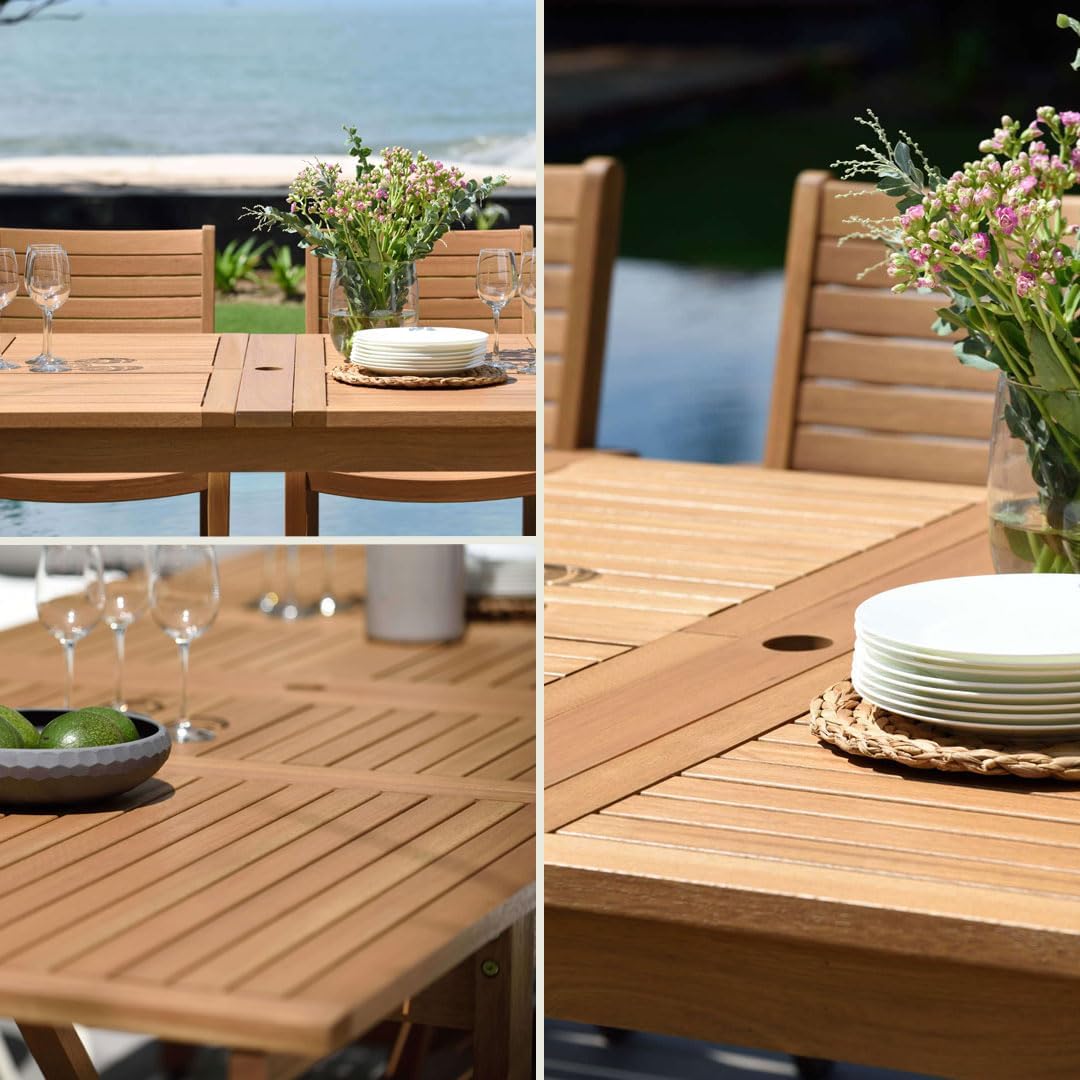
Buying a patio dining set for ten or eleven people is a genuinely different project than picking up a standard six-seater. At this scale you’re not shopping for furniture — you’re planning an outdoor room. A patio dining set is simply a coordinated table-and-chair package sold together, so the proportions, finish, and style match out of the box. The challenge at 10–11 seats is that very few sets are sold pre-configured at that size: you usually start with an 8-seat set and add a bench, a couple of extra chairs, or a table extension leaf. That sounds straightforward, but if you don’t nail the space math first, you’ll either crowd your guests or end up with a gorgeous table stranded in a patio too small to pull a chair back from. This guide will walk you through the sizing numbers, the material trade-offs at this price tier (roughly $800 to $3,000+), and a clear decision framework so you leave with the right call for your climate and your crowd.
| EDITOR'S PICK[Grade-A Teak Outdoor Dining Set](https://www.amazon.com/dp/B071YSSXQW?tag=greenflower20-20)… | Mid-tierOutdoor Patio Furniture. New 9p… | Budget pick[PURPLE LEAF Outdoor Dining Set](https://www.amazon.com/dp/B0C4SNY3WP?tag=greenflower20-20)… | |
|---|---|---|---|
| Table material | Teak | Indonesian Teak | Aluminum |
| Table size | 95"x40" | 95"x40" | — |
| Chair count | 8 | 8 | — |
| Chair type | Java Arm Chairs | Patara Stacking Arm Chairs | Padded Chairs |
| Seating | 9 | 9 | 11 |
| Price | $2,450.00 | $2,450.00 | $1,399.00 |
| See on Amazon → | See on Amazon → | See on Amazon → |
The Sizing Math First — Everything Else Is Secondary
This is the step most buyers skip, and it’s the reason the number-one patio regret — according to Architectural Digest’s outdoor design coverage — is ordering a set that physically doesn’t fit the intended space once chairs and human beings are added.
Here’s the core math:
By the numbers
- Table footprint for 10–11: typically 110–130 inches long × 38–44 inches wide
- Clearance behind each chair (to pull out and seat a person): 36 inches minimum, 42 inches preferred
- Clearance for a walking path behind occupied chairs: 48–60 inches
- Minimum total patio dimension for a 10-seat setup: roughly 18 feet × 13 feet (216” × 156”)
Work backward from your patio’s actual dimensions before you look at a single product photo. Measure the hard edges — pergola posts, built-in planters, the edge of your deck — not just the open concrete or wood surface. Then subtract your clearance zones on all four sides of the table. Whatever rectangle remains is your usable table footprint. If that rectangle is shorter than about 110 inches, a 10-seat configuration is going to feel like a fire-code violation every time someone stands up.
Extension leaves — removable panels that slide into the center of a table to add 18–24 inches of length — are your best friend at this seat count. A table that closes to 84 inches for a Tuesday family dinner and opens to 118 inches for Thanksgiving weekend is genuinely more useful than a fixed 120-inch table that dominates the space year-round. Wirecutter’s outdoor dining coverage consistently highlights extension-capable tables as the smarter buy for anyone who entertains inconsistently, which is most of us.
One more number worth knowing: chair width. Standard outdoor dining chairs run 20–22 inches wide. Eleven chairs at 21 inches each is nearly 20 linear feet of seating. That math alone tells you why a 10-person patio table set demands serious real-estate planning.
Material Trade-Offs at the 10–11 Seat Scale
At this size, the material choice hits harder than at smaller scales. A 48-inch bistro table in questionable aluminum is annoying if it rusts. A 120-inch dining table in the same material is a $1,200 regret that you look at every day for five years. Here’s how the main options stack up when you’re buying big.
Powder-Coated Aluminum
Powder coating is a dry finishing process — think baked-on paint, but thicker and harder — applied over aluminum frames. It’s not the same as spray paint. A properly powder-coated aluminum frame resists rust, doesn’t require seasonal sealing, and weighs about a third of what wrought iron weighs, which matters enormously when you’re moving a 120-inch table.
The quality marker to look for is stage count: a two-stage powder coat (primer + topcoat) is the baseline; three-stage (phosphate wash + primer + topcoat) is the standard at the $1,500–$2,500 price point and should last 8–12 years in most climates without recoating, per This Old House’s material durability coverage. At the 10-seat scale, you’re almost always looking at commercial-grade or “hospitality-grade” aluminum, which is the same framing spec used in restaurant outdoor seating. That’s a meaningful quality jump over entry-level residential sets.
Best climate fit: Coastal or humid climates where iron and steel would corrode. Powder-coated aluminum doesn’t mind salt air, humidity, or rain cycles.
Trade-off: High-end powder-coated sets can feel lighter underfoot than solid teak or cast iron — some owners report in long-run reviews that the chairs shift on smooth concrete during a crowd. Rubber feet or anti-slip pads solve this, but it’s worth knowing.
Teak
Teak is a dense tropical hardwood that produces its own natural oils, giving it exceptional resistance to moisture, insects, and UV degradation — without any treatment required, at least initially. A quality teak dining table at 10 seats will run $2,000–$4,500 for the set, which is a serious budget conversation. What you’re buying is longevity: owners in long-run reviews consistently report teak sets functioning beautifully at 15–20 years with minimal maintenance.
The critical quality variable is grade. Look for Grade A teak, which comes from the heartwood (the dense, oil-rich center) of mature plantation-grown trees. Grade B and C teak come from outer sections with lower oil content and will gray, crack, and warp faster. The FSC (Forest Stewardship Council) certification on teak furniture confirms the wood comes from responsibly managed plantations rather than old-growth forests — it’s worth asking for the certification document when you’re comparing vendors at this price point.
Maintenance reality check: Teak weathers to a silver-gray patina naturally, which many people love. If you want to maintain the golden-brown color, you’ll need to apply teak oil annually — a 2–3 hour job on a 120-inch table with 10 chairs. Consumer Reports’ outdoor furniture guide notes that skipping this doesn’t structurally harm the furniture, but it does change the aesthetic. Budget teak oil into your 5-year cost of ownership if the color matters to you.
Best climate fit: Universally good, but especially worth the premium in wet, humid climates where other materials need more active maintenance.
Trade-off: Weight. A solid teak dining table at this size can weigh 80–120 pounds. Moving it seasonally or repositioning it on the patio is a two-person job. If you’re on a rooftop deck or a second-floor balcony with weight restrictions, confirm load ratings before you buy.
All-Weather Wicker (Resin Wicker)
The term “all-weather wicker” means synthetic resin strands woven over an aluminum frame — it’s not natural wicker, which would degrade outdoors within a couple of seasons. Resin wicker sets at the 10-seat scale typically run $900–$1,800, which is where this material earns its place in the conversation.
Quality varies enormously by resin type. High-density polyethylene (HDPE) resin is the standard for quality outdoor furniture — it resists UV fading, cracking, and brittleness far better than lower-grade vinyl or PVC resins. The practical test that reviewers reference: HDPE wicker flexes slightly without cracking when you press it; cheaper resin wicker feels rigid and may show hairline surface cracks within 2–3 seasons of sun exposure.
Best climate fit: Dry to moderate climates. Resin wicker handles rain fine, but prolonged standing water in weave gaps — common in heavy rain regions — can stress the frame joints over time. It also tends to hold heat in direct desert sun, which some owners in southwestern U.S. climates flag in long-run reviews.
Trade-off: At 10 seats, the visual weight of a large resin wicker set can feel heavier than it is in person. Request photos of the full set assembled if you’re buying online — the proportions at this scale can look different than the stock photography suggests.
Cast Iron and Steel
Cast iron and wrought iron bring undeniable visual presence, and owners consistently report that a cast iron dining set — maintained properly — outlasts almost any other material. The weight is both the selling point and the practical limitation: a 120-inch cast iron table can approach 200 pounds. At 10–11 seats you’re essentially making a permanent placement decision.
Steel sets (as distinct from cast iron) are lighter but require diligent maintenance in humid or coastal climates. Powder-coated steel is more affordable than aluminum at comparable finishes, but steel can still rust at exposed edges, welds, and chips in the coating. This Old House’s material coverage recommends touching up any paint chips on steel furniture within the same season they appear, before the rust cycle starts.
Best climate fit: Dry inland climates where the set won’t be exposed to persistent moisture. Not recommended for coastal zones without serious protective covers and annual inspection.
Cushions, Covers, and 5-Year Cost of Ownership
The sticker price of a 10-seat patio dining set is only the opening bid. Here’s what the real number looks like:
- Cushions: A quality set of 10 seat cushions in Sunbrella fabric (solution-dyed acrylic, the industry durability benchmark for outdoor textiles, per Sunbrella’s own product documentation) runs $400–$900 depending on thickness and style. Budget cushions in polyester will fade and compress within 2–3 seasons.
- Furniture cover: A fitted cover for a 120-inch dining set runs $80–$180 from quality brands. Plan on replacing it every 3–4 years.
- Maintenance materials: Teak oil, touch-up paint for steel, or UV protectant spray for resin wicker — budget $30–$60/year.
- Replacement chairs: Extended sets often mix a core set with add-on chairs; over 5–7 years, individual chairs occasionally need replacement. Confirming that the manufacturer still sells matching chairs before you buy the set is a step most buyers skip and later regret.
A realistic 5-year cost of ownership on a $1,500 aluminum set with quality cushions and a cover is closer to $2,300. A $3,000 teak set over the same period, needing only teak oil and a cover, often comes out comparably — and the teak is likely still in excellent condition at year 10.
The Decision Framework: If X, Then Y
Here’s the honest if-then grid:
- If you’re in a coastal or high-humidity climate and want minimal maintenance → powder-coated aluminum, three-stage finish, $1,500–$2,500 range.
- If you’re willing to invest once and want the set to outlast your mortgage → Grade A FSC-certified teak, budget $2,500–$4,500 for the full set.
- If budget is the primary constraint and you’re in a dry or moderate climate → HDPE resin wicker over aluminum frames, $900–$1,500, accept that you’ll likely replace in 8–10 years rather than 15.
- If aesthetics are the top priority and you’re inland with low humidity → cast iron, but plan your placement as permanent and budget for annual inspection and touch-up.
- If your patio is borderline on space → prioritize an extension-leaf table design over a fixed-length table at any material tier; the flexibility is worth more than any finish upgrade.
The size math doesn’t lie, and the material trade-offs are more honest than most product listings will tell you. Lock in your patio dimensions first, confirm your clearance zones, then let the climate and your maintenance tolerance guide the material decision. At 10–11 seats, you’re buying a serious outdoor room. Take the extra week to get it right.