A 6-person patio dining set is exactly what it sounds like: a table plus six chairs (or a bench combination) designed to live outside year-round or through an entire outdoor season. Unlike indoor dining furniture, outdoor sets have to survive UV rays, humidity swings, rain, and sometimes snow — so the material the frame and tabletop are made from matters enormously. If you’ve already spent time comparing sets online, you’ve probably hit the same wall most shoppers do: the product pages say “weather-resistant” about everything, the prices range from $300 to $3,000+, and no one explains why. This guide breaks down every major material, shows you what you’ll actually spend over five years (not just the sticker price), and — most importantly — gives you the one sizing check you need to do before you buy anything. Read this first, then shop.
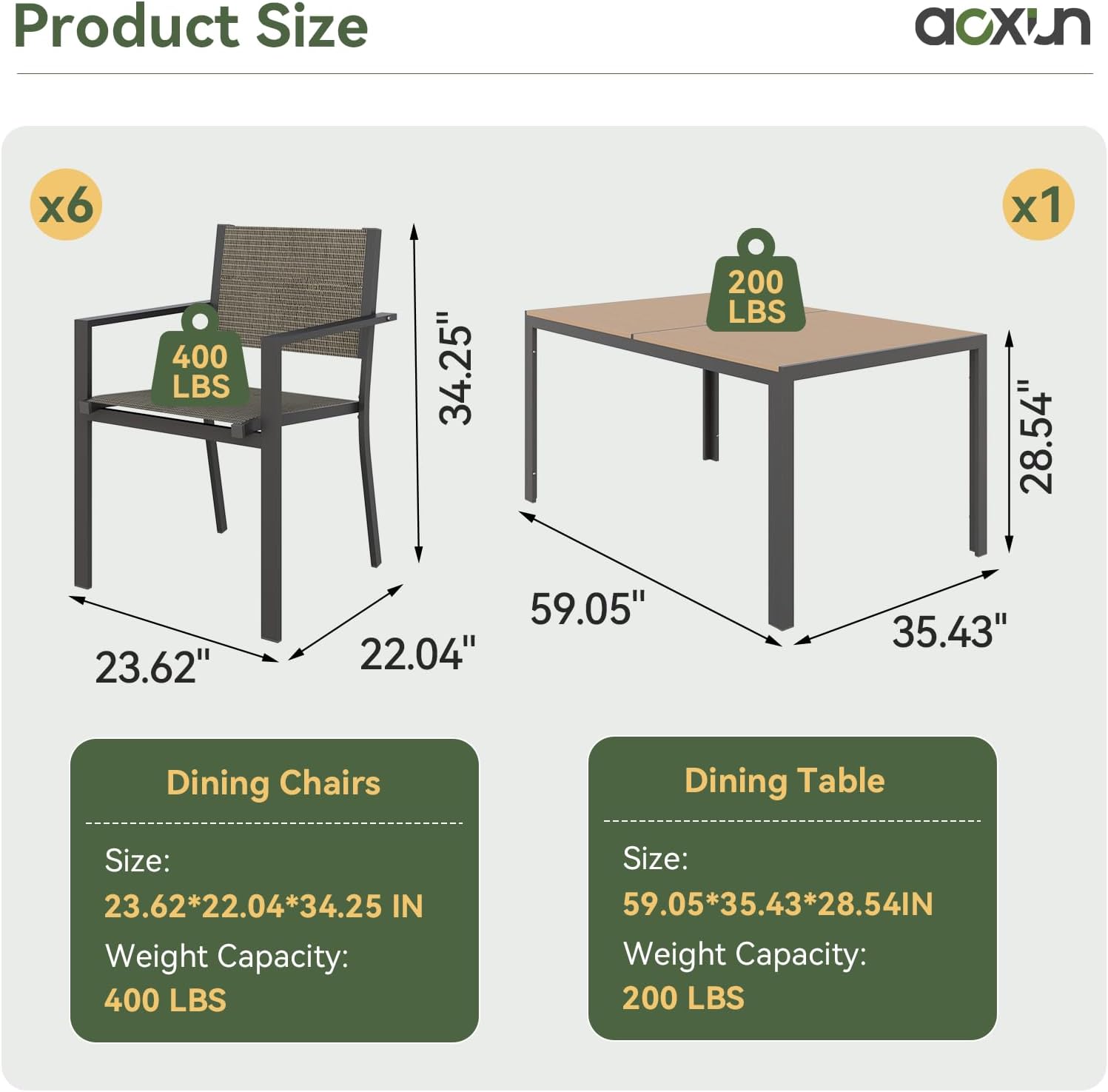
| EDITOR'S PICK[PURPLE LEAF Outdoor Dining Set](https://www.amazon.com/dp/B0F9YGBK6L?tag=greenflower20-20)… | Mid-tier[SERWALL 7-Piece Patio Dining Ta](https://www.amazon.com/dp/B0CNSR9QHT?tag=greenflower20-20)… | Budget pick[Aoxun 7-Piece Patio Table and C](https://www.amazon.com/dp/B0GKFFKCHN?tag=greenflower20-20)… | |
|---|---|---|---|
| Material | Aluminum | HDPE | Metal |
| Pieces | 11 | 7 | 7 |
| Umbrella Hole | — | ✓ | — |
| Chair Material | Padded | — | Textilene |
| Price | $1,399.00 | $599.99 | $269.99 |
| See on Amazon → | See on Amazon → | See on Amazon → |
Step One: The Sizing Check That Prevents the #1 Patio Regret
More returned patio sets come from sizing errors than from quality disappointments. Do this math before you fall in love with a table.
Minimum space formula for a 6-person set:
- A rectangular table seating 6 is typically 72–84 inches long and 36–40 inches wide (that’s 6 to 7 feet long).
- Chairs need 24 inches of pull-out clearance on every side that has a seat.
- Add a 36-inch walkway around the entire furniture footprint so people can move without squeezing.
Quick calculation: Take your patio’s usable length. Subtract 72 inches for the table. Subtract 48 inches for chair pull-out on both ends. Subtract 72 inches for walkways on both long sides. If that number goes negative, a standard 6-person rectangular set won’t fit comfortably.
By the numbers — minimum patio size for a 6-person dining set:
| Layout | Table Size | Minimum Patio Footprint Needed |
|---|---|---|
| Rectangular, chairs both ends + sides | 72” × 36” | ~13 ft × 10 ft |
| Round (seats 6, tighter) | 60” diameter | ~11 ft × 11 ft |
| Bench one side, chairs other | 72” × 36” | ~13 ft × 9 ft (bench reduces pull-out) |
A 60-inch round table is a legitimate 6-person option and it fits smaller square patios better than a rectangle — Gardenista’s outdoor dining material guide specifically calls out round tables as the right call for patios under 120 square feet. Don’t default to rectangular just because it’s what you picture.
Material Breakdown: Honest Trade-Offs at Every Price Point
Here’s where most buyer guides go soft. They list materials and say things like “teak is premium” without telling you when teak is worth it and when it isn’t. Let’s fix that.
Aluminum (Powder-Coated)
Price range for a 6-person set: $350–$1,800
What it is: Aluminum frames are either cast (poured into molds, heavier, more ornate) or extruded (shaped through a die, lighter, cleaner lines). The finish is almost always powder-coated — meaning a dry paint powder is electrostatically applied and baked on, creating a hard shell that resists rust and UV far better than wet spray paint.
The quality marker that matters: Powder coat is applied in stages. Entry-level sets often get a single-stage coat. Better sets use a two-stage process (primer + topcoat) or three-stage (phosphate wash + primer + topcoat). This Old House’s outdoor furniture guide notes that multi-stage powder coating — combined with aluminum’s natural rust resistance — is what makes mid-range aluminum sets genuinely durable rather than just marketing language.
Trade-offs: Lightweight is a real advantage (easy to move, won’t rot, won’t rust) but it’s also a disadvantage in windy climates — a gust can send chairs across the yard. Owners on high-wind decks consistently report needing chair clips or a storage plan. The look trends modern-to-transitional; if you want something that reads “traditional garden,” cast aluminum can get there, but extruded can’t.
5-year cost reality: Low upkeep. Budget $0–$60 for a furniture cover and maybe $40 for replacement cushions at year 3 if you bought basic foam. Total 5-year cost on a $600 set: roughly $700–$750. Hard to beat for the money.
If X, then Y: If your climate has high humidity or salt air (coastal), aluminum is the practical pick over steel or iron at any price point. It won’t rust. Period.
Teak
Price range for a 6-person set: $1,200–$3,500+
What it is: Teak is a dense tropical hardwood naturally high in silica and oils, which makes it resistant to rot, insects, and moisture without any finish. It’s the material that ages most gracefully outdoors — starting honey-gold and weathering to a silver-gray patina over a season or two.
The quality marker that matters: Teak comes in grades. Grade A (also called FAS — Firsts and Seconds) is cut from the dense heartwood at the center of the log. Grade B and C include more sapwood, which is lighter in color, less oily, and less durable. Furniture marketed as “teak” without a grade designation is often Grade B or C. Architectural Digest’s outdoor dining set coverage and Gardenista’s material guide both emphasize checking for FSC certification (from the Forest Stewardship Council, an independent body that verifies responsible sourcing) as a baseline before buying any teak.
Trade-offs: Teak is genuinely the longest-lived option — reviewers and long-term owners consistently report sets functioning well at 15–20 years with minimal maintenance. But “minimal” doesn’t mean zero. If you want to keep the honey color, you’ll apply teak oil once a year (about $30/year in product). If you let it go gray, no maintenance needed — but some buyers are surprised when their $2,000 table turns silver and assume something is wrong. Nothing is wrong. That’s the material doing its job.
5-year cost reality: High entry, low ongoing cost. A $1,800 set with annual oiling and a quality furniture cover: ~$2,050 over five years. The math doesn’t favor teak on a per-year basis unless you keep the set for 10+ years, which many owners do.
If X, then Y: If you’re buying once and keeping it for a decade-plus — and your budget allows — teak is the only material where the long-term cost-of-ownership math genuinely works in its favor. If you’re in an apartment or plan to move in five years, aluminum wins.
Resin Wicker (All-Weather Wicker)
Price range for a 6-person set: $400–$1,500
What it is: This is not the natural wicker your grandparents had on their porch. All-weather wicker (also called resin wicker or synthetic wicker) is high-density polyethylene (HDPE) or resin fiber woven over an aluminum or steel frame. It mimics the look of natural wicker but is UV-stabilized and waterproof.
The quality marker that matters: The frame underneath the weave matters as much as the weave itself. An aluminum inner frame means no rust; a steel inner frame will eventually rust at weave gaps in humid climates, showing as orange staining on the weave. Apartment Therapy’s patio dining coverage consistently flags this as the hidden failure point in budget wicker sets.
Trade-offs: Resin wicker is the most comfortable visual option — it reads casual, relaxed, and layered — but it’s the most maintenance-intensive in the long run. The weave can loosen or crack from UV exposure after 5–8 years even on quality sets, and there’s no good field repair. Cushions are usually not optional; most resin wicker chairs have open seats.
5-year cost reality: Factor in cushion replacement (roughly $80–$150 for a 6-chair set of replacement pads at year 3) and a cover. A $700 set over 5 years: ~$900–$1,000 total. Reasonable — just know the 8-year mark often means a new set.
If X, then Y: If aesthetics and budget are both constrained — you want something that photographs well and costs under $800 — resin wicker with an aluminum inner frame is the right move. If you’re in a very high-UV climate (Arizona, Florida, coastal), step up to the $1,000+ range and look for UV-stabilized HDPE weave specifically.
Cast Iron and Steel
Price range for a 6-person set: $500–$2,000
What it is: Cast iron sets are heavy, ornate, and traditional — the classic French bistro look scaled up to a dining table. Powder-coated steel is lighter and more contemporary. Both rust if the coating fails.
Trade-offs: Weight is both the appeal and the liability. A cast iron table and six chairs can total 200–400 lbs — which means they stay put in wind and feel substantial, but they’re genuinely hard to move for cleaning or storage. Owners consistently report that inspecting and touching up chips in the powder coat annually is the non-negotiable maintenance task; a missed chip can rust through within a season in a wet climate.
If X, then Y: Cast iron makes sense if you have a covered patio (it never moves and you want the traditional look) or a very stable climate. For exposed patios in rain-heavy or coastal regions, aluminum replicates the look with far less long-term risk.
The 5-Year Cost Comparison You Should Actually Use
Sticker price is the wrong number. Here’s what you’re really committing to:
| Material | Typical 6-Person Set Price | 5-Year Add-Ons (cover, cushions, maintenance) | Realistic 5-Year Total |
|---|---|---|---|
| Aluminum (mid-range) | $600 | $100–$150 | ~$750 |
| Resin Wicker | $700 | $200–$300 | ~$950 |
| Cast Iron / Steel | $800 | $150–$250 | ~$1,050 |
| Teak (Grade A) | $1,800 | $200–$300 | ~$2,100 |
Teak looks expensive and is expensive — but at year 10 it’s often still the only set standing, while the others may have been replaced once.
The Decision Framework: Match Material to Your Actual Situation
Stop optimizing for the material that sounds best and start matching to your real conditions.
Coastal or high-humidity climate? → Aluminum first, teak second. Steel and iron are last resorts.
Covered patio or screened porch? → Any material works; weight and aesthetics can lead. Cast iron is genuinely beautiful here.
High-UV / desert climate (Southwest)? → Look specifically for UV-stabilized resin wicker or powder-coated aluminum with a light color (dark colors absorb heat noticeably). Teak fades faster to gray here.
Cold winters with freeze-thaw cycles? → Aluminum and teak handle freeze-thaw well. Resin wicker can crack in extreme cold; cast iron survives but the coating needs annual inspection.
Budget under $600? → Aluminum is the honest answer. Resin wicker at this price point usually has a steel inner frame. Teak at this price point doesn’t exist (and if it claims to, it’s not Grade A).
Planning to keep the set 10+ years? → Teak is the only material where the long-term math genuinely works in your favor, per the 5-year cost table above extended to a decade.
Do the sizing check first. Then pick your climate-matched material. Then shop by price within that lane. In that order — not the reverse.