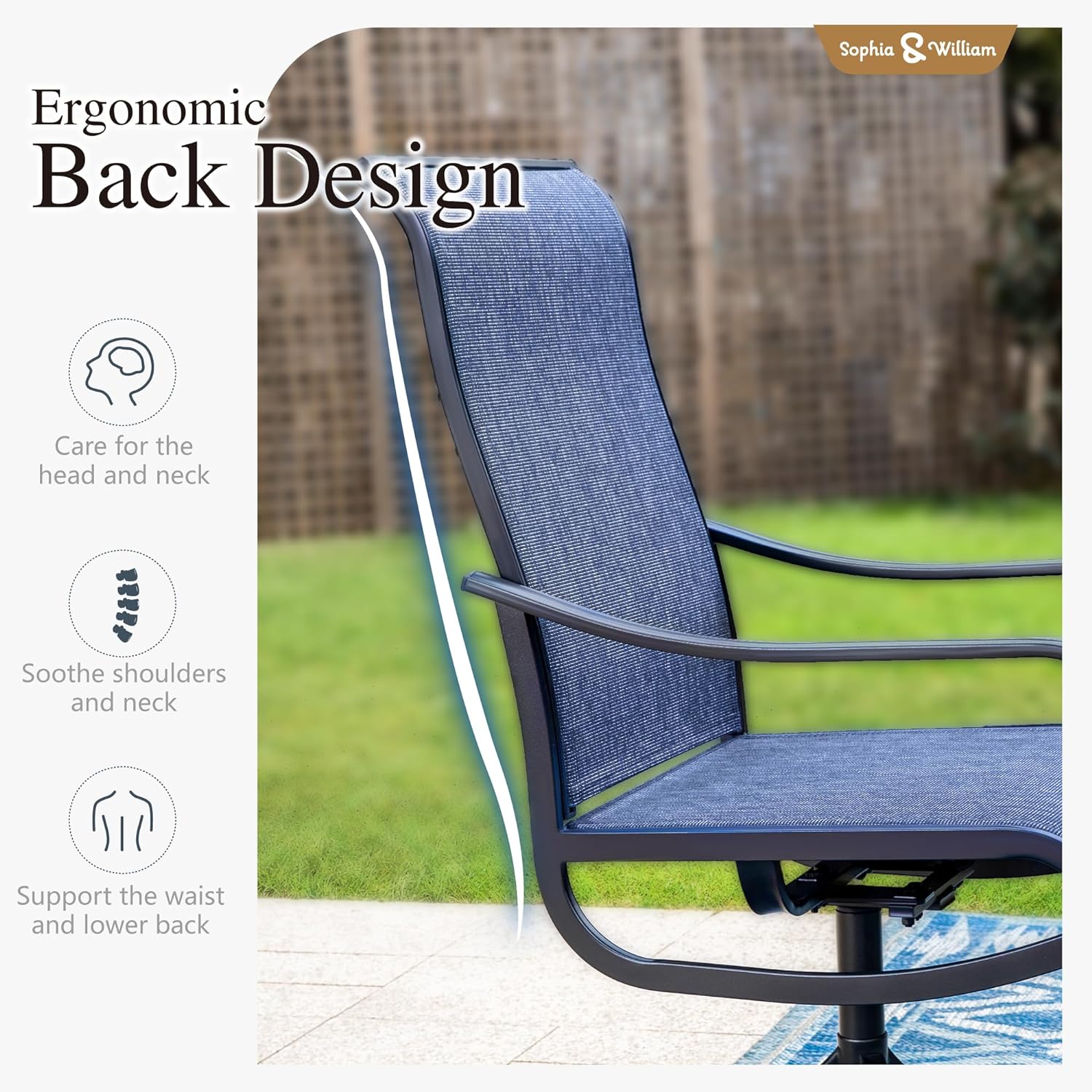
Aluminum patio dining sets occupy a strange middle zone in the outdoor furniture market: the cheapest ones feel like lawn chairs at a church picnic, and the best ones look like something out of a European resort catalog — and both are technically “powder-coated aluminum.” Powder coating is a finishing process where electrostatically charged paint particles are sprayed onto bare metal and then baked on in an oven, creating a hard shell that resists rust, chips, and UV fading far better than liquid paint. The problem is that “powder coated” appears on a $299 patio set from a big-box clearance aisle and on a $1,800 dining set from a specialty outdoor retailer — and the difference between them isn’t marketing language. It’s measurable. This guide breaks down exactly what separates premium aluminum sets from budget ones, shows you the cost math over a realistic ownership horizon, and ends with a clear decision rule so you know which category is actually right for your situation.
| EDITOR'S PICK[PURPLE LEAF 11 Pieces Patio Din…](https://www.amazon.com/dp/B0FP52P3P8?tag=greenflower20-20) | Mid-tier[PURPLE LEAF Outdoor Dining Set…](https://www.amazon.com/dp/B0F9YDQ2VD?tag=greenflower20-20) | Budget pick[HAPPATIO 9-Piece Patio Dining S…](https://www.amazon.com/dp/B0BRKVLVSM?tag=greenflower20-20) | |
|---|---|---|---|
| Piece count | 11 | 9 | 9 |
| Seating capacity | — | 8 | 8 |
| Material | Aluminum frame | Aluminum frame | All aluminum |
| Chair weave | Wicker | Rope weave | — |
| Price | $2,204.99 | $2,099.00 | $999.99 |
| See on Amazon → | See on Amazon → | See on Amazon → |
What “Premium” Actually Means in Aluminum Patio Furniture
The outdoor furniture industry doesn’t have a universal “premium” label, so retailers fill the vacuum with words like “commercial grade,” “resort quality,” and “architectural aluminum.” Some of those phrases track to real specs. Many don’t. Here’s what to look for instead.
Wall thickness and alloy grade. Aluminum furniture is built from hollow extrusions (the tubing that forms chair legs and table frames). Entry-level sets typically use 1.0–1.2 mm wall thickness; premium sets run 1.5–2.0 mm. Thicker walls resist denting, flex less when weight shifts, and give the piece a noticeably sturdier feel that owners consistently describe as “substantial” in long-run reviews. The alloy matters too: 6061 and 6063 series aluminum are the grades most commonly cited in commercial outdoor furniture spec sheets for their balance of corrosion resistance and workability.
Powder-coat specification tier. This is where budget and premium sets diverge most measurably. The American Architectural Manufacturers Association publishes three voluntary coating standards — AAMA 2603, 2604, and 2605 — that define how well a powder coat resists UV fading, humidity, and salt spray over time. Per the AAMA standards documentation:
By the numbers
- AAMA 2603: minimum 1-year fade/chalk resistance — common on entry-level sets
- AAMA 2604: 5-year performance standard — typical on mid-range to premium residential
- AAMA 2605: 10-year performance standard — found on commercial-grade and top-tier residential sets
- Entry-level sets often carry no AAMA rating at all
Most manufacturers don’t advertise their AAMA tier prominently, but a 10-second scan of the spec sheet or a call to the retailer will tell you. If a brand can’t answer the question, that itself is useful information.
Weld quality and joint construction. At the premium tier, structural joints are typically TIG-welded (a precise, clean welding process) and finished so smoothly the seam is nearly invisible. Budget sets frequently use visible pop-rivets or mechanical fasteners that become corrosion points over time, especially in coastal climates. This Old House’s outdoor furniture overview notes that joint integrity is one of the first places cost-cutting shows up in mass-market outdoor pieces.
Cast versus extruded aluminum components. Some premium sets mix cast aluminum (poured into molds, allowing decorative detail and complex curves) with extruded tubing. Cast components add weight, visual richness, and structural rigidity at corners — they’re part of why certain sets look architectural rather than utilitarian. This distinction shows up clearly in reviews at Architectural Digest, where editors consistently distinguish “cast aluminum dining sets” as a separate quality tier from entry extruded-only designs.
The 5-Year Cost of Ownership: Where the Math Changes
Sticker price comparisons are almost always misleading in this category. Here’s the honest version of the math, built around a 6-person dining set:
Entry-level set ($350–$500)
- Replacement cushions, years 2–3: $80–$150
- Touch-up paint or refinishing after coating chips: $30–$60
- Cover (if not included): $40–$60
- Likelihood of full replacement by year 5–6: moderate to high, per Consumer Reports’ outdoor furniture buying guide, which notes that sub-$500 sets show measurable frame degradation within 4–6 seasons in humid or coastal climates
- Realistic 5-year outlay: $550–$800+, plus the inconvenience of shopping again
Premium set ($900–$1,800)
- Replacement cushions are often Sunbrella-grade fabric (Sunbrella’s published fabric spec puts their solution-dyed acrylic at 2,000+ hours of UV exposure without significant fading), meaning later replacement is optional rather than mandatory
- Frame typically warrants 5–15 years depending on brand
- Cover: $60–$100
- Touch-up or refinishing: unlikely in the 5-year window at AAMA 2604/2605 spec
- Realistic 5-year outlay: $1,000–$2,000, but you still have the furniture
The crossover point — where premium becomes the rational economic choice — typically lands around year 3 to 4. If you move frequently, rent, or are furnishing a seasonal-only space, the math shifts toward a quality mid-range set rather than the top tier. Gardenista’s aluminum vs. teak material guide makes a similar point: premium aluminum only beats its cost-per-year math if you’re planning to stay put and maintain the furniture reasonably well.
Climate Matching: When Premium Powder Coat Earns Its Keep
Not every climate punishes outdoor furniture equally. Here’s where the premium tier’s specs actually matter — and where they’re overkill.
High-value situations for premium aluminum:
- Coastal and high-humidity climates. Salt air is the single harshest environment for outdoor furniture finishes. AAMA 2604/2605-rated coatings have a measurably longer failure timeline in salt-spray testing than unrated or 2603-spec finishes. Owners in Florida, the Gulf Coast, and Pacific coastal zones consistently report that budget aluminum frames show rust bleed at joints within 2–3 seasons, while premium frames with proper coating hold for 7+ years.
- High UV zones (Southwest, high altitude). UV degradation is the primary cause of color fade and coating chalking. The higher the AAMA tier, the longer the color holds. If you’re buying in a colorway you care about — matte charcoal, sage green, terracotta — the premium coating is what keeps it looking intentional rather than sun-bleached.
- Year-round outdoor use. Furniture that stays outside 12 months a year faces roughly double the thermal cycling (expansion and contraction as temperatures swing) of seasonally stored pieces. Thicker walls and better welds handle thermal stress more gracefully. Owners who don’t store furniture through winter report that premium-grade sets show no joint loosening after 5+ years, while budget sets often develop wobble in legs and seat frames within 3 seasons.
Where premium is overkill:
- Mild, dry inland climates (Pacific Northwest interior valleys, most of the Mountain West except high UV). A well-maintained mid-range set with AAMA 2603 or unrated coating will easily last 6–8 years. The extra spend buys marginal performance improvement in these conditions.
- Covered patios and screened porches. If the furniture is shielded from direct rain and UV, the coating spec matters far less. Structural quality still matters, but you don’t need to pay for the full environmental-resistance premium.
- Rental properties or staging situations. A durable mid-range set that photographs well serves the function without the long-term investment rationale.
What to Actually Look For When Shopping: The 5-Checkpoint System
Knowing the theory is useful. Here’s how to translate it into a real shopping decision, whether you’re in a showroom or reading a product page.
1. Ask or search for the powder-coat spec. Look for “AAMA 2604” or “AAMA 2605” in the product description or spec sheet. Absence isn’t automatically disqualifying, but it means you’re trusting the brand’s quality control without independent spec backing.
2. Check wall thickness in the specs. Anything listed at 1.5 mm or above is in the premium range. Under 1.2 mm is entry-level territory regardless of what the description says.
3. Look at the joint finishing in photos. Clean, smooth welds with no visible pop-rivets signal better construction. Zoom in on the leg-to-seat and leg-to-cross-brace joints in product photography — this is where budget sets give themselves away.
4. Evaluate the cushion fabric spec. Sunbrella and comparable solution-dyed acrylic fabrics (look for “solution-dyed” in the description — that means color runs through the entire fiber, not just the surface) extend the cushion replacement interval dramatically. A premium frame with budget polyester cushions will still require cushion replacement in year 2–3.
5. Confirm the warranty terms and what they cover. A 5-year frame warranty that explicitly covers coating failure and corrosion is a meaningful quality signal. A “1-year limited warranty” covering only manufacturing defects is standard language that tells you very little.
The Decision Rule
If your situation fits more than two of these conditions, the premium tier — $900 to $1,800 for a 6-person set — earns its price over a realistic ownership horizon:
- You’re within 10 miles of a coastline, or in a climate with 60%+ average relative humidity
- The furniture will live outdoors year-round without seasonal storage
- You’re planning to stay in the home for 5+ years
- You care about color consistency (dark tones, saturated hues) holding over time
- You’ve replaced a cheaper set before and remember what that felt like
If you check one or none of those boxes, a well-built mid-range set in the $450–$800 range — ideally from a brand that publishes wall thickness and uses at minimum an AAMA 2603-rated finish — is the honest recommendation. The premium tier’s performance edge is real, but it only pays off when the environment and ownership timeline actually put that performance to work.
The furniture that’s right for you isn’t the most expensive one. It’s the one whose specs match the specific weather, sunlight, and salt exposure it’s going to face — and that you’re still happy you bought in year six.
Disclosure: patiotablesets.com participates in affiliate programs. If you purchase through links on this site, we may earn a commission at no extra cost to you. Our editorial recommendations are based on published specs, aggregated owner reviews, and category research — not on affiliate relationships.