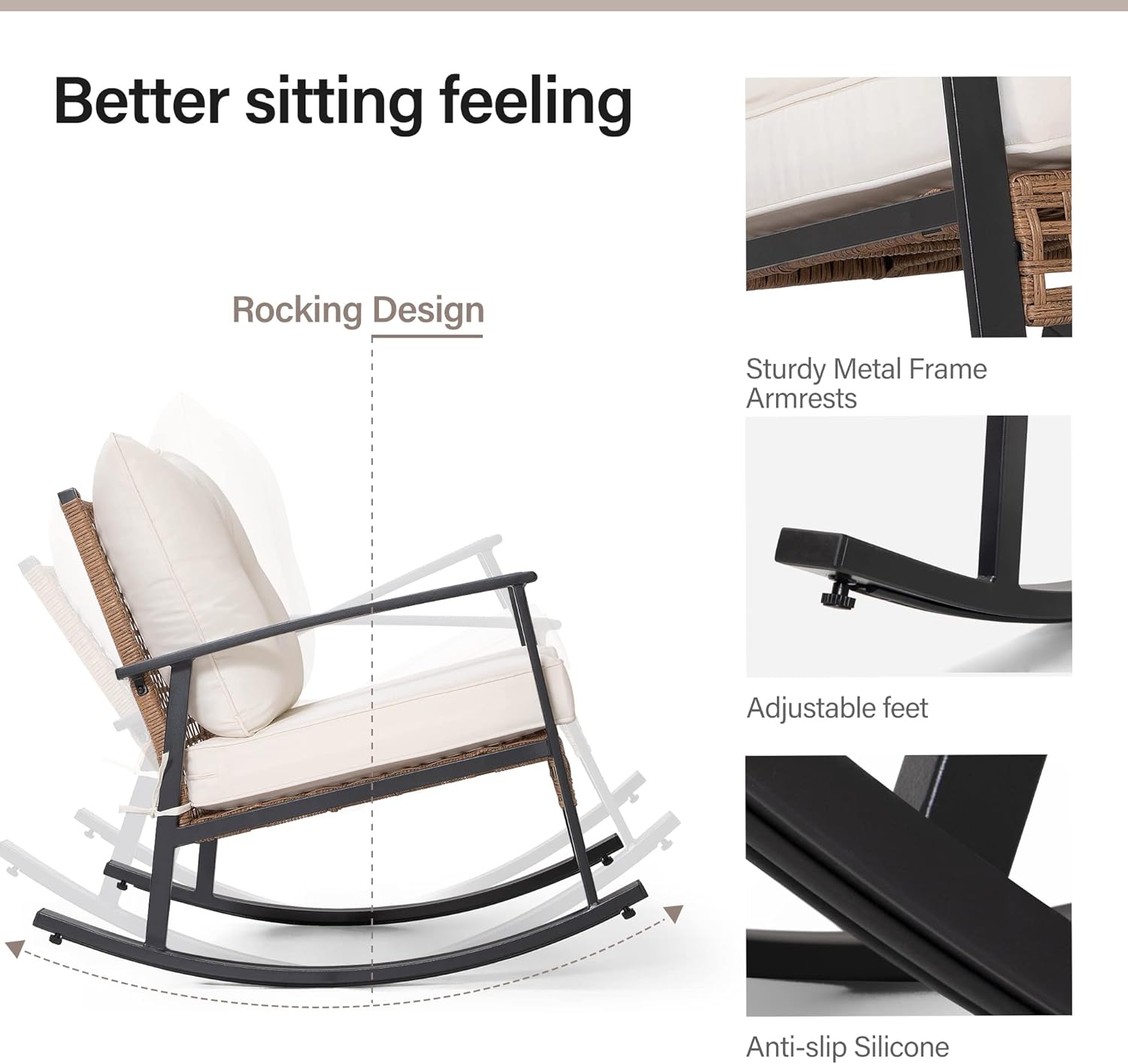
A bistro set is the three-piece format you’ve probably seen at sidewalk restaurants: two chairs and one small round table, scaled for conversation rather than full dining. A rocking bistro set is that same compact configuration, but the chairs are rockers — curved-base chairs designed to let you shift your weight rhythmically rather than sitting stiff and still. On a front porch, that combination does something a standard bistro set or a pair of fixed Adirondacks can’t quite pull off: it gives you a social anchor point that’s comfortable enough for a long evening, small enough not to block foot traffic, and visually polished enough to work as the porch’s centerpiece rather than an afterthought. If you’re trying to decide between a rocking bistro set and a more conventional chair-and-side-table arrangement, this article lays out the real trade-offs — size math, material durability, cost of ownership over five years — so you can make the call with confidence.
Why the Format Itself Is Doing Most of the Work
Before we get into materials and price tiers, it’s worth naming what a rocking bistro set is actually solving that a standard porch chair-and-table combo often doesn’t.
A typical front porch scenario goes like this: two separate chairs get positioned at angles toward the yard, with a small side table wedged in between. The problem is that the side table is almost always the wrong height for the chair arm, the chairs drift apart over the season, and the whole thing reads as improvised rather than intentional. You end up with furniture that functions but doesn’t feel like a room.
A matched rocking bistro set fixes three things simultaneously:
-
Proportion: The table and chairs are designed at the same scale. The table height (usually 27–30 inches — call it “counter-adjacent,” shorter than a dining table but taller than a coffee table) matches the seated elbow height of the accompanying rockers, so drinks and plates sit at a natural arm’s reach without requiring a lean or a stretch.
-
Visual cohesion: Because all three pieces come from the same line, material, and finish, the set reads as deliberate — a decision, not an accumulation. House Beautiful’s roundups of bistro sets consistently note that matched sets photograph better and sell homes faster during listing season, which is a proxy metric for visual impact.
-
Conversation geometry: Rockers positioned at 90–120 degrees around a small round table naturally orient two people toward each other and toward the yard simultaneously. It’s a fundamentally better conversational geometry than two chairs sitting side-by-side on a porch railing.
The rocking motion itself adds what furniture ergonomists call active rest — your body is making small postural adjustments constantly, which delays the fatigue that makes people push back from a stationary chair after 20 minutes. Owners of rocking bistro sets consistently report staying on the porch longer than they expected, which is the whole point.
The Real Size Math for Front Porches
This is where most buyers stumble. Front porches have a different spatial logic than backyard patios: you’re working with a long, narrow corridor, not an open rectangle.
Minimum clearance rules (measure before you shop):
| Dimension | Minimum | Comfortable |
|---|---|---|
| Porch depth (chair to railing) | 6 ft | 7–8 ft |
| Set footprint, table + chairs fully extended | 48–54 in. diameter | 60 in. diameter |
| Clearance from door swing to nearest chair | 18 in. | 24 in. |
| Clearance from chair to porch column | 12 in. | 18 in. |
Most rocking bistro sets ship with a 24–30 inch round table and chairs that need roughly 24 inches of depth each when fully rocked back. So your real occupied footprint when two people are seated and rocking is closer to 5 feet wide × 5 feet deep. On a porch less than 6 feet deep, you’re either hanging the rockers over the edge or cramping the table forward — neither is functional.
This Old House’s outdoor furniture guidance recommends a minimum 36-inch clearance between any seated furniture and a traffic path. On a front porch, that traffic path is the route from the door to the steps. Sketch that path first, then work backwards to what fits.
Rule of thumb: If your porch is 6 feet deep and 8–10 feet wide, a rocking bistro set with a 24-inch table and standard rockers fits with one good furniture arrangement. If you’re under 6 feet deep, look for “compact rockers” (a category designation some manufacturers use, meaning the chair depth is under 34 inches rather than the typical 38–42 inches for a full-size rocker).
Material Trade-offs for This Specific Format
Rocking bistro sets exist in four main materials, and the rocking mechanism is the variable that changes the durability math compared to static chairs.
Aluminum (Powder-Coated)
Powder-coating is a dry finishing process where electrostatically charged powder is baked onto the metal frame — the result is a hard, even surface that resists rust, chipping, and UV degradation better than spray paint. Entry-level sets use two-stage powder coating; premium sets use four-stage processes with a zinc primer layer underneath.
For a rocking bistro set specifically, aluminum has one key advantage: the rocking joints (where the curved base meets the chair leg) are under repeated flex stress. In powder-coated aluminum, that joint is typically welded and then coated, which holds up well over five-plus years. Architectural Digest’s outdoor furniture guides consistently call powder-coated aluminum the best “set it and forget it” material for porches that aren’t sheltered from rain.
Five-year cost of ownership: Low. No annual sealing or oiling. Cushion replacement every 2–3 years is usually the only recurring cost.
Teak
Teak is a tropical hardwood that contains natural oils making it highly resistant to moisture, insects, and UV damage without any sealing. Gardenista’s teak outdoor furniture guide explains the grading system worth knowing: Grade A teak comes from the heartwood (the dense center of the tree) and is the most durable; Grade B mixes heartwood and sapwood; Grade C is mostly sapwood and won’t last more than a few seasons outdoors.
For rocking bistro sets, solid teak construction at the joints is critical — the rocking base is often a separate curved piece mortise-and-tenoned (interlocked and glued without metal fasteners) into the rear legs. That joint, in Grade A teak, is extremely durable. In Grade B or lower, it’s a five-year failure point.
Teak grays to a silver-driftwood tone without oiling, which many buyers find appealing. If you want to preserve the warm honey color, annual teak oil application is required. That’s a real cost — both money and time.
Five-year cost of ownership: Medium-high. Sticker price starts higher ($600–$1,200 for a quality set), but no cushion is required (though most buyers add one), and maintenance is optional depending on your aesthetic preference.
Resin Wicker Over Aluminum Frame
Resin wicker (sometimes called “all-weather wicker”) is a synthetic weave — typically high-density polyethylene (HDPE) — wrapped around a metal frame. It’s not the natural wicker you’d find on a vintage porch; natural wicker will degrade outdoors within 1–2 seasons. Resin wicker is designed to resist UV, moisture, and temperature swings.
For a rocking bistro set, the frame underneath the weave matters as much as the weave itself. Look for an aluminum or steel inner frame; lower-cost sets sometimes use a plastic or hollow tube frame that can crack at the rocking joint within 2–3 years under repeated use.
Owners of resin wicker rocking sets frequently note that the wicker weave at high-flex points (near the rocking base connection) can loosen or fray first. Reviews across aggregated sources suggest this shows up around year 3–4 in entry-level sets, and year 6–8 in premium constructions.
Five-year cost of ownership: Medium. Lower entry price than teak ($300–$700 for a solid set), cushions required, and the frame’s longevity is frame-dependent.
Cast Iron
Cast iron is heavy, ornate, and genuinely long-lasting — but it’s a niche choice for a rocking bistro set because the weight makes a rocker difficult to move and the rocking joints are prone to surface rust if the protective coating chips. This Old House notes that cast iron outdoor furniture requires annual touch-up painting to prevent oxidation at joints and welds.
If you’re in a covered, low-humidity porch environment and you want the Victorian aesthetic, cast iron delivers it authentically. For most front porches with seasonal weather exposure, it’s the most demanding material in the rocking format.
The Decision Framework: If X, Then Y
By now you have the conceptual model. Here’s how to translate it into a buying decision:
If your porch is under 6 feet deep → shop specifically for compact rocking bistro sets with a chair depth under 34 inches. Don’t let a beautiful full-size set crowd your entry.
If you’re in a high-humidity coastal or rainy climate → powder-coated aluminum is the lowest-maintenance choice. Teak works too if you’re willing to let it gray or commit to annual oiling. Skip cast iron unless the porch is fully covered.
If you want 5+ years of durability without annual maintenance → budget at least $400–$600 for aluminum or $700+ for Grade A teak. Below those thresholds, the rocking joints and frame construction tend to show their limits before year 4.
If you’re furnishing a rental property or a porch with hard weather exposure → HDPE resin wicker on a welded aluminum frame at the $350–$500 price point is the pragmatic pick. It looks good, takes abuse, and the cost of replacement at year 5 is still less than a premium teak set.
If aesthetics are the primary driver and budget is flexible → teak is the format that ages visibly well. Architectural Digest’s coverage of long-term outdoor furniture consistently returns to teak as the material whose patina improves rather than degrades the look over years.
If you’re uncertain whether a rocking set will actually work on your porch → measure the door swing clearance first. That’s the dimension buyers overlook most consistently, and it’s the one that forces furniture returns.
The rocking bistro format isn’t for every porch. But if yours has the depth for it, this three-piece configuration earns its keep in a way that a collection of mismatched pieces simply doesn’t. The rocking motion keeps people in their chairs. The matched table geometry means drinks and conversation both land in the right place. And a well-chosen material means you’re not back at this decision in three years.
Do the size math, pick the material that matches your climate and maintenance tolerance, and spend enough to clear the quality floor on the rocking joint. That’s the whole decision.