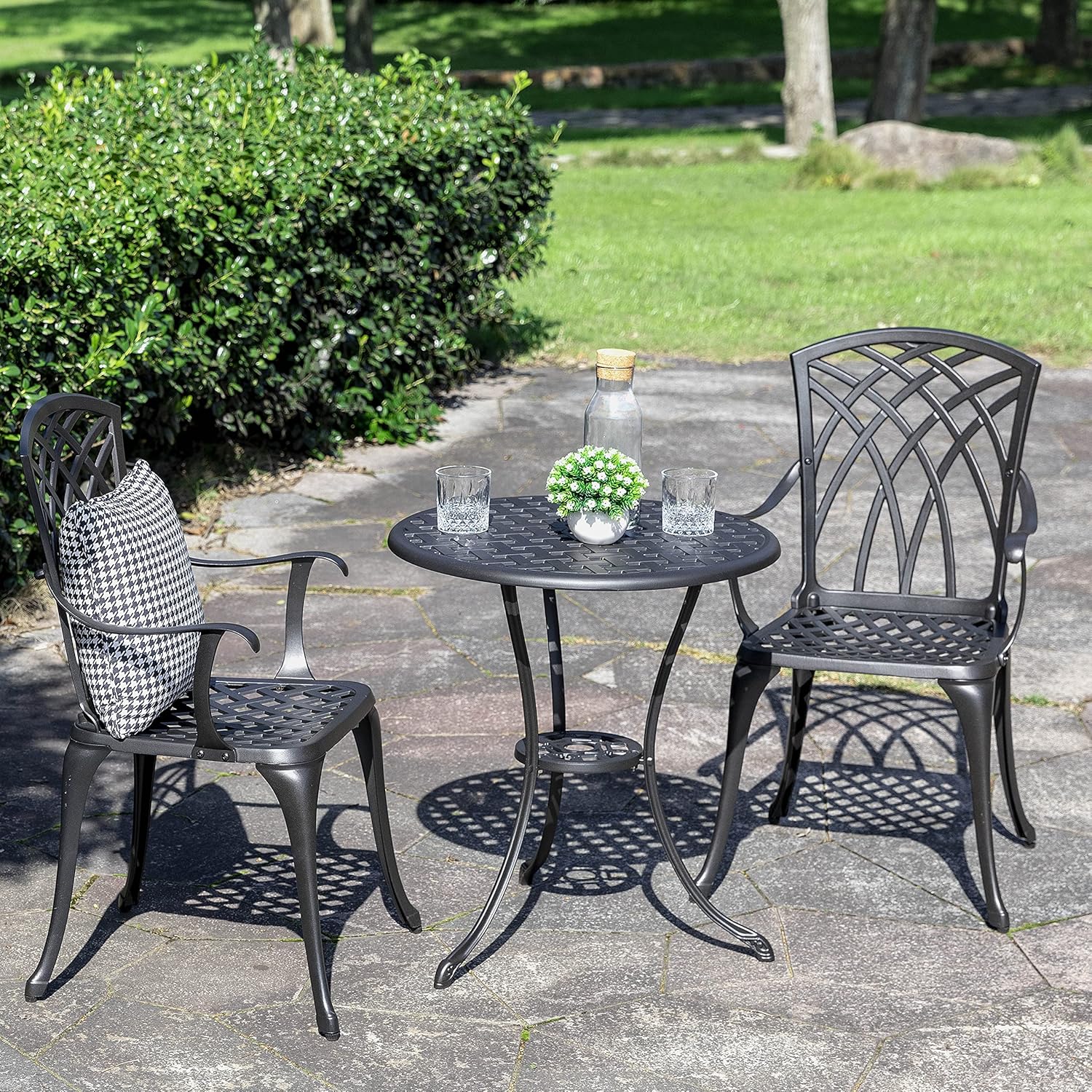
A bistro set — the term just means a small two-seat table-and-chair combo originally inspired by Parisian sidewalk seating — sounds like the perfect solution for a tight balcony or compact patio. And it often is. But “small” is doing a lot of work in that sentence. A 24-inch round bistro table sitting on a 36-inch-wide apartment balcony leaves no room to pull a chair back without scraping the railing. A set marketed as “space-saving” can still fail you if the chairs stack awkwardly or the table legs catch on a drain cover. The #1 patio regret we hear from readers isn’t choosing the wrong material or the wrong style — it’s ordering without measuring first. This guide gives you the exact sizing rules, the honest material trade-offs, and a clear decision framework so you buy right the first time.
| EDITOR'S PICK[LAUSAINT HOME 3-Piece Rocking B…](https://www.amazon.com/dp/B0BT9MCVMS?tag=greenflower20-20) | Mid-tier[Best Choice Products 3-Piece Ac…](https://www.amazon.com/dp/B075GYS5H1?tag=greenflower20-20) | Budget pick[Grand patio 3-Piece Bistro Set…](https://www.amazon.com/dp/B07MC3V467?tag=greenflower20-20) | |
|---|---|---|---|
| Material | Rattan | Acacia Wood | Steel |
| Folding | ✗ | ✓ | ✓ |
| Seat Cushions | ✓ | ✗ | ✗ |
| Table Type | 2-Tier | Round | — |
| Rocking | ✓ | ✗ | ✗ |
| Color Finish | Beige | Teak | Yellow |
| Price | $199.99 | $164.99 | $99.99 |
| See on Amazon → | See on Amazon → | See on Amazon → |
The Sizing Math You Cannot Skip
This is where most buyers short-circuit. They see a table listed as “24 inches round” and think: my balcony is 4 feet deep, that fits. It doesn’t — not once you factor in chairs, clearance, and the human body actually using the thing.
The three numbers that govern every bistro set purchase:
-
Table diameter or footprint. Most bistro tables run 23–28 inches in diameter for round tops, or 24×24 to 28×28 inches for square tops. The table itself is rarely the constraint.
-
Chair pull-out depth. A chair pushed in sits roughly 16–18 inches from the table edge. Pulled out enough to actually sit down, add another 14–18 inches. Per Apartment Therapy’s outdoor-space measuring guide, you need a minimum of 32 inches of clearance from the table edge to any wall, railing, or obstacle behind the chair. Plan for 36 inches if you want to feel comfortable rather than just technically able to move.
-
Side-to-side clearance. Leave at least 24 inches between the outer edge of one chair and any wall or adjacent furniture. On a narrow balcony, this is often the constraint that rules out a set — not depth but width.
The practical formula:
Minimum balcony/patio depth needed = table diameter ÷ 2 + 36 inches (for one chair pullout) + ~12 inches buffer from back wall = roughly 5 to 6 feet of usable depth for a standard bistro set.
Minimum width needed = table diameter + 24 inches on each side = roughly 6 feet for a 24-inch table.
If your space is smaller than those numbers, you’re not necessarily out of luck — but you need to shop specifically for folding chairs, wall-mount fold-down tables, or “balcony bistro” sets explicitly engineered for sub-5-foot depths (several aluminum and resin options exist in the $150–$350 range). Architectural Digest’s roundup of small balcony furniture notes that purpose-built balcony sets with trapezoid-shaped tops or rail-mount brackets can reclaim 8–12 inches of functional depth compared to a standard round-top set.
By the numbers — Quick Bistro Set Sizing Reference:
| Space Depth | Recommended Table Size | Chair Style |
|---|---|---|
| Under 4 ft | Skip freestanding; consider wall-mount fold-down | Folding or stacking only |
| 4–5 ft | 20–23 in. round, max | Folding or sled-base |
| 5–6 ft | 24–26 in. round or square | Standard bistro chair |
| 6 ft+ | Up to 28 in. round or 28×28 square | Full bistro or café chair |
Material Trade-offs for Tight, Exposed Spaces
Small patios and balconies create two compounding problems that larger patio sets don’t face as severely: exposure and storage. A ground-level patio at least gets some wind buffering from fencing and landscaping. A fourth-floor balcony is essentially a wind tunnel with intermittent rain. And when winter comes, a small balcony offers almost no room to store furniture — the set stays out or it doesn’t fit back through the door.
Here’s how the main bistro-set materials actually play out under those conditions.
Steel and Powder-Coated Steel ($150–$400)
The classic bistro look — the French café silhouette with the scrollwork back — is almost always steel. Powder coating (a dry paint applied electrostatically and baked on) is what stands between the steel and rust. Quality matters enormously here. Cheap powder coating applied in one thin stage will begin chalking and chipping within 18–24 months in coastal or high-humidity climates, per This Old House’s outdoor furniture materials guide. Better sets use a multi-stage process: chemical wash, primer coat, then powder top coat. You can’t see this difference at point of sale, but you can ask the retailer or check the spec sheet for “multi-stage powder coat” or “electrostatic primer.”
Verdict: If you’re in a mild, dry climate (Denver, Phoenix, inland suburban) and you cover or store the set over winter, a powder-coated steel bistro set in the $200–$350 range is an excellent value. If you’re in a coastal, humid, or freeze-thaw climate, steel requires more maintenance discipline or a higher upfront investment in quality coating.
Aluminum ($250–$800)
Cast aluminum (poured into a mold) and tubular aluminum (hollow extruded frames) both resist rust entirely — aluminum oxidizes but doesn’t rust through the way steel does. This makes aluminum the most forgiving material for year-round outdoor exposure. It’s also light enough that a two-person bistro set can be repositioned or stored by one person without drama.
The trade-off is feel. Aluminum bistro chairs tend to be slightly less warm underfoot and can feel less substantial than their steel counterparts at the same price point. Gardenista’s bistro buyer’s guide notes that cast aluminum, specifically, holds detail well and produces the closest visual match to traditional wrought iron at a fraction of the weight — a meaningful distinction if the classic scrollwork aesthetic matters to you.
Verdict: For balcony use, humid climates, or anyone who wants minimal maintenance, aluminum is the practical default. Budget $300–$500 for a set that will age gracefully over 5–7 years.
Resin Wicker / All-Weather Wicker ($180–$600)
“Resin wicker” means the weave is made from polyethylene (PE) plastic strands, not natural rattan or reed. This matters because natural wicker disintegrates outdoors; resin wicker is designed for it. The quality range is wide. Low-density PE wicker turns brittle and cracks in UV exposure within 2–3 years. High-density PE (HDPE) wicker, sometimes labeled “commercial-grade,” holds color and flexibility significantly longer — owners in long-run reviews consistently report HDPE sets looking presentable at the 5-year mark in full-sun conditions.
For bistro-scale sets specifically, resin wicker on steel frames is common. Check whether the frame is steel or aluminum: the wicker hides the frame visually, but the frame determines corrosion behavior in wet climates.
Verdict: Resin wicker works well in protected spaces (screened porches, covered patios). On a fully exposed balcony with intense UV and no shade, HDPE quality becomes a non-negotiable. Consumer Reports’ outdoor furniture buying guide consistently flags UV resistance as the leading failure mode for wicker sets under $300.
Teak and Hardwood ($600–$2,500+)
Teak bistro sets exist and are genuinely beautiful, but they’re rare at the two-seat scale and represent a significant investment for a category typically used casually. If you’re drawn to teak, verify FSC certification (the Forest Stewardship Council certifies sustainably harvested wood — their certification database is searchable at fsc.org) and understand that untreated teak will silver over 12–18 months outdoors. That silvering is natural and structurally harmless, but it surprises buyers expecting the warm honey color to persist without annual oiling.
Verdict: Teak is hard to justify for a balcony bistro set unless you’re committed to long-term ownership and the aesthetic is central to your outdoor design. At this scale, aluminum and powder-coated steel deliver 80% of the visual payoff at 20–40% of the cost.
The Decision Framework: If X, Then Y
You’ve measured your space. You’ve mapped the materials. Here’s how to collapse the remaining choices into a clear path.
If your usable depth is under 5 feet: Shop only for sets explicitly sized for balcony use with folding or sling-back chairs. Do not assume a standard bistro set will fit because the table is “small.” Measure chair depth pulled out, not pushed in.
If you’re in a coastal, humid, or high-rain climate: Default to aluminum frames. Powder-coated steel is viable but requires discipline about seasonal covers and annual touch-up of any chips — skip it if you won’t follow through. Avoid resin wicker under $350 in fully exposed, high-UV conditions unless you’re treating it as a 3-year buy.
If you want the classic French bistro look: Cast aluminum is your best material-to-aesthetic match for anything under $600. Steel scrollwork sets deliver the look at lower cost but demand better maintenance habits. Either way, the look is defined more by the chair back design than the material, so prioritize finding a silhouette you love and then assess the frame material.
If budget is the primary constraint: A powder-coated steel set in the $180–$280 range, covered through winter and stored in a dry space, can realistically last 5–7 years in a mild climate. Don’t buy the cheapest outdoor cushions to go with it — cushion failure is often what drives “set replacement” when the frame itself is still sound. Sunbrella-grade fabric (solution-dyed acrylic that resists fading and mildew) on cushions costs more upfront but typically outlasts the frame. Per Sunbrella’s own care documentation, solution-dyed fabric retains color significantly longer under UV exposure than piece-dyed alternatives.
If you’re furnishing a screened porch or covered patio: The weather exposure constraints relax considerably. Material choice can shift toward aesthetics and comfort. At this point, wicker on a powder-coated steel frame in the $300–$500 range is a strong value, and teak becomes worth considering if it fits your 5-to-8-year ownership horizon.
One Last Check Before You Buy
Before you finalize any bistro set purchase, do this: tape out the table footprint and the full chair clearance on your balcony or patio floor using painter’s tape. Walk through the mock setup. Sit down in a chair positioned where it would actually live. Check that the railing doesn’t catch your elbow when you turn to talk to someone. This takes eight minutes and catches the problems that product photos and dimension tables miss.
The readers who report the highest satisfaction with their bistro sets — consistently, across review aggregates and long-run ownership reports — are the ones who treated the sizing step as seriously as the material choice. The set you’ll love at year five is almost always the one that fit your space comfortably at day one.