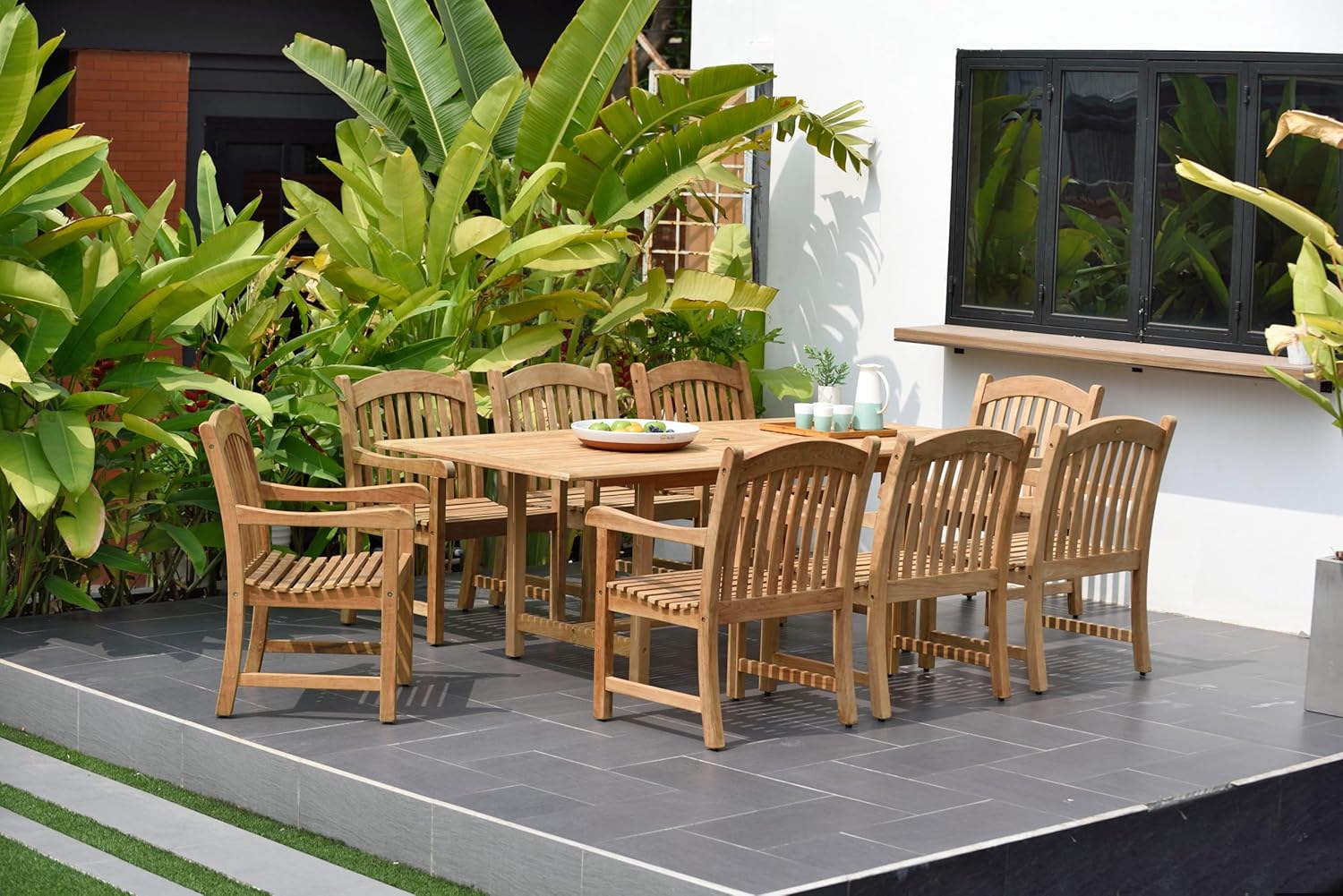
If you’re standing in a patio showroom — or scrolling product pages at midnight — you’ve probably seen “Grade A Teak” stamped on sets ranging from $800 to $3,500. It sounds like a government certification, something official. It isn’t. Teak grading is an industry convention, not a regulated standard, which means any retailer can print it on a hang tag without consequence. That’s the first thing worth knowing. The second is that real Grade A teak — harvested from the dense, oil-rich heartwood (the dark center of a mature teak tree) — genuinely does last 25 to 30 years outdoors with modest upkeep, while lower grades can look rough in five. This guide will help you decode what the label actually signals, show you the quality markers that matter more than the grade name, and give you a clear decision framework for whether the premium price is justified for your situation.
Why “Grade A” Doesn’t Mean What You Think
The teak furniture industry broadly uses three grade designations — A, B, and C — but no single body enforces their definitions. Here’s the practical translation:
Grade A is supposed to indicate heartwood-only cuts: uniform golden-brown color, tight grain, high natural oil content, minimal knots or sapwood (the pale, outer ring of the tree). This oil content is what makes teak genuinely weather-resistant without sealants or covers. As This Old House’s teak outdoor furniture guide explains, the natural silica and oils in teak heartwood repel water, resist rot, and deter insects — properties that synthetic materials try to replicate but never quite match.
Grade B typically includes more sapwood, wider grain, and more visible knots. It’s still real teak, but with less oil concentration and more susceptibility to cracking and graying in the first few years.
Grade C is often off-cuts and reclaimed plantation wood — serviceable, but unpredictable in durability.
The problem: a retailer selling Grade B wood can legally call it Grade A. So the label alone is not your buying signal. The buying signals are below.
The Quality Markers That Actually Predict Longevity
1. Color consistency and grain density. Genuine Grade A heartwood is uniformly golden to medium brown with a tight, straight grain. Sapwood intrusions look like pale yellow or white streaks. A few small streaks in a chair leg are normal; large patches or alternating light/dark sections across a tabletop are a red flag.
2. Joint construction. High-quality teak sets use mortise-and-tenon joinery (where one piece slots into a carved hole in another — no metal brackets required) and stainless steel hardware where fasteners are needed. Cheaper sets rely on aluminum or zinc alloy screws that corrode and loosen within a few seasons. Gardenista’s teak care guide specifically flags corroded fasteners as the leading cause of structural failure in mid-grade sets — the wood outlasts the hardware by a decade.
3. FSC certification. The Forest Stewardship Council (FSC) certifies that teak was harvested from responsibly managed plantations, primarily in Indonesia and Myanmar. Per the FSC’s certification standards, the chain-of-custody documentation should be verifiable on the FSC’s public database by entering the certificate number. Ethical sourcing and quality correlate in practice: manufacturers committed to certified plantation teak also tend to be more rigorous about heartwood selection, because plantation yields are expensive and they’re not willing to waste them on shoddy assembly.
4. Weight. Teak is dense — a six-person dining table in solid Grade A teak should weigh 90–130 lbs depending on design. If a “teak” table feels surprisingly light, you’re likely looking at teak veneer over a cheaper wood core, or Grade C with significant sapwood. Owners reviewing heavier sets consistently report better long-term stability and less warping.
5. Origin transparency. Reputable manufacturers name their teak source — Indonesian plantation teak is the current gold standard for sustainability and consistency. Vague sourcing language like “exotic hardwoods” or “tropical wood” is a soft warning.
The Real Cost of Ownership: A 7-Year Math Check
The sticker shock on quality teak sets is real. A six-person Grade A teak dining set from a reputable brand runs $1,800–$2,800 as of mid-2026. An entry-level aluminum set might be $350–$600. The question isn’t which costs less — it’s which costs less per year of good-looking, structurally sound use.
By the numbers — 7-year cost of ownership:
| Category | Entry Aluminum ($450 set) | Grade A Teak ($2,200 set) |
|---|---|---|
| Initial purchase | $450 | $2,200 |
| Cushion replacement (2×) | $200 | $200 |
| Refinishing / sealing | $0 | $80 (optional teak oil, 3 applications) |
| Replacement likelihood by year 7 | High (rust, paint failure) | Very low |
| 7-year total estimate | $1,050–$1,400 | $2,480–$2,600 |
The aluminum set often gets replaced at years 4–5 when powder coat (the baked-on paint finish that protects aluminum from oxidizing) begins to chip and rust sets in on hardware. That’s a second purchase cycle. Wirecutter’s outdoor furniture review notes that mid-price aluminum sets without marine-grade or ASGC-certified powder coat commonly show paint failure within five years in coastal or high-humidity climates. Grade A teak, by contrast, is documented in owner reviews at seven, ten, and fifteen years to still be structurally sound — it silvers to a driftwood gray if left untreated (which many owners prefer), but doesn’t fail. Architectural Digest’s best outdoor dining sets coverage consistently highlights teak’s longevity as its primary competitive advantage over other natural and synthetic materials.
The math gap narrows considerably if you’re in a mild, low-humidity climate and buying the aluminum set for a screened porch where UV and moisture exposure are limited. That’s the one scenario where mid-grade aluminum’s cost advantage holds.
Sets Worth the Splurge (and One Honest Middle-Ground Pick)
A note on how these recommendations were made: they’re based on published specifications, manufacturer documentation, aggregated owner reviews across retail platforms, and editorial research — not firsthand testing.
For Six-Person Dining (The Most Common Search)
The benchmark: Look for a rectangular table in the 72”–78” range (seats six comfortably with 24” per person) paired with six arm chairs or a mix of armchairs and side chairs. Oval tables read slightly larger at the same footprint, which helps in tight spaces.
Owners consistently rate sets from brands like Amazonia, Cambridge Casual, and Royal Teak Collection as delivering verifiable Grade A wood with transparent FSC documentation available upon request. Across aggregated reviews, the pattern with these brands is positive on joinery quality and wood consistency, with the occasional complaint about shipping damage (a teak furniture universal) rather than material quality.
One honest middle-ground option: If $2,000+ is genuinely not in the budget, consider a teak and powder-coated aluminum hybrid — teak tabletop, aluminum frame — in the $700–$1,100 range. You get the surface warmth and weather resistance of teak where it matters most (the top) while reducing total weight and cost. The trade-off is that the aluminum legs need the same scrutiny you’d give a full aluminum set: look for 3-stage powder coat and stainless hardware. Reviewers describe these as a practical middle path, though they note the aesthetic isn’t as cohesive as full-teak sets.
For Smaller Patios (Under 200 sq ft)
A bistro-style teak table (round, 36”–42” diameter) with two folding or stackable teak chairs in the $400–$800 range is a legitimate Grade A option. Folding teak chairs from reputable manufacturers are documented to hold up as well as fixed-frame versions — the mortise joints on folding mechanisms are actually a good stress test of a manufacturer’s joinery quality.
Sizing checkpoint: Before ordering anything, pull out a tape measure and mark your actual table footprint on the patio with painter’s tape. Add 36” of clearance on all sides for chair pull-out and walking space. If you can’t get those clearances, go down one size or go round — a 48” round seats four almost as comfortably as a 60” rectangle and saves 12–18 inches of linear depth.
If X, Then Y: Your Decision Framework
If you’re in a coastal or high-humidity climate (Florida, Pacific Northwest, Gulf Coast): Grade A teak is the clear long-term winner. Salt air destroys powder coat on aluminum within 2–4 years even at mid-grade, and resin wicker (HDPE-based synthetic wicker) holds up but lacks the structural integrity for dining-height tables under regular use. Teak’s oil content is specifically why it was used for ship decks for centuries.
If you’re in a dry or mild climate (Mountain West, inland California, low-humidity Midwest): The cost case for Grade A teak weakens. High-quality powder-coated aluminum or a teak-top hybrid performs well for 8–10 years in these conditions, and you can redirect the price difference.
If you plan to leave the set out year-round with no covers: Teak handles this better than any other natural material. It will silver — some owners love this, some don’t — but it won’t rot or delaminate. Apply teak oil once a year if you want to maintain the golden color; skip it if you prefer the silver patina.
If you’ll use furniture covers consistently and store cushions seasonally: The gap between teak and quality aluminum narrows. Covers significantly extend aluminum’s lifespan, and teak’s weather-resistance advantage matters less when protection is already in place.
If the label says Grade A but the price is under $600 for a full dining set: Be skeptical. That’s not impossible — some Indonesian manufacturers sell direct with lower margins — but it warrants close scrutiny of joinery, hardware spec, and sourcing documentation before buying. At that price, ask for the FSC certificate number and verify it.
Disclosure: This site uses affiliate links. If you purchase through our product recommendations, we may earn a commission at no additional cost to you. Our editorial recommendations are made independently of those arrangements.