You can spend $400 on a wicker conversation set — the kind with a loveseat, two chairs, and a glass-topped coffee table — and have it crumbling and faded in three summers. You can also spend $1,200 on a similar-looking set and still be rearranging it on your deck a decade later without a single cracked strand. The difference almost never shows up in the product photos. It lives in the resin type (the synthetic plastic used to mimic traditional wicker weaving) and in how tightly and densely that resin strand is woven over the frame. This guide breaks down both factors in plain language, shows you the numbers that matter on a spec sheet, and ends with a clear decision rule so you can stop second-guessing and order with confidence.
| EDITOR'S PICK[SUNSHINE VALLEY Swivel Glider P…](https://www.amazon.com/dp/B0DCG8S75F?tag=greenflower20-20) | Mid-tierHERA'S HOUSE Patio Furniture Set | Budget pick[Aoxun Aluminum Patio Furniture…](https://www.amazon.com/dp/B0F5MSQY3L?tag=greenflower20-20) | |
|---|---|---|---|
| Material | Brown Wicker Rattan | Brown Wicker | Aluminum |
| Pieces | 7 | 5 | 7 |
| Chairs type | Swivel Glider | Swivel | — |
| Cushion thick | — | 5.5" | Thick |
| Firepit incl. | ✓ | ✗ | ✗ |
| Cover incl. | — | — | ✓ |
| Price | $1,656.99 | $1,208.99 | $749.99 |
| See on Amazon → | See on Amazon → | See on Amazon → |
Why “All-Weather Wicker” Isn’t One Thing — It’s a Spectrum
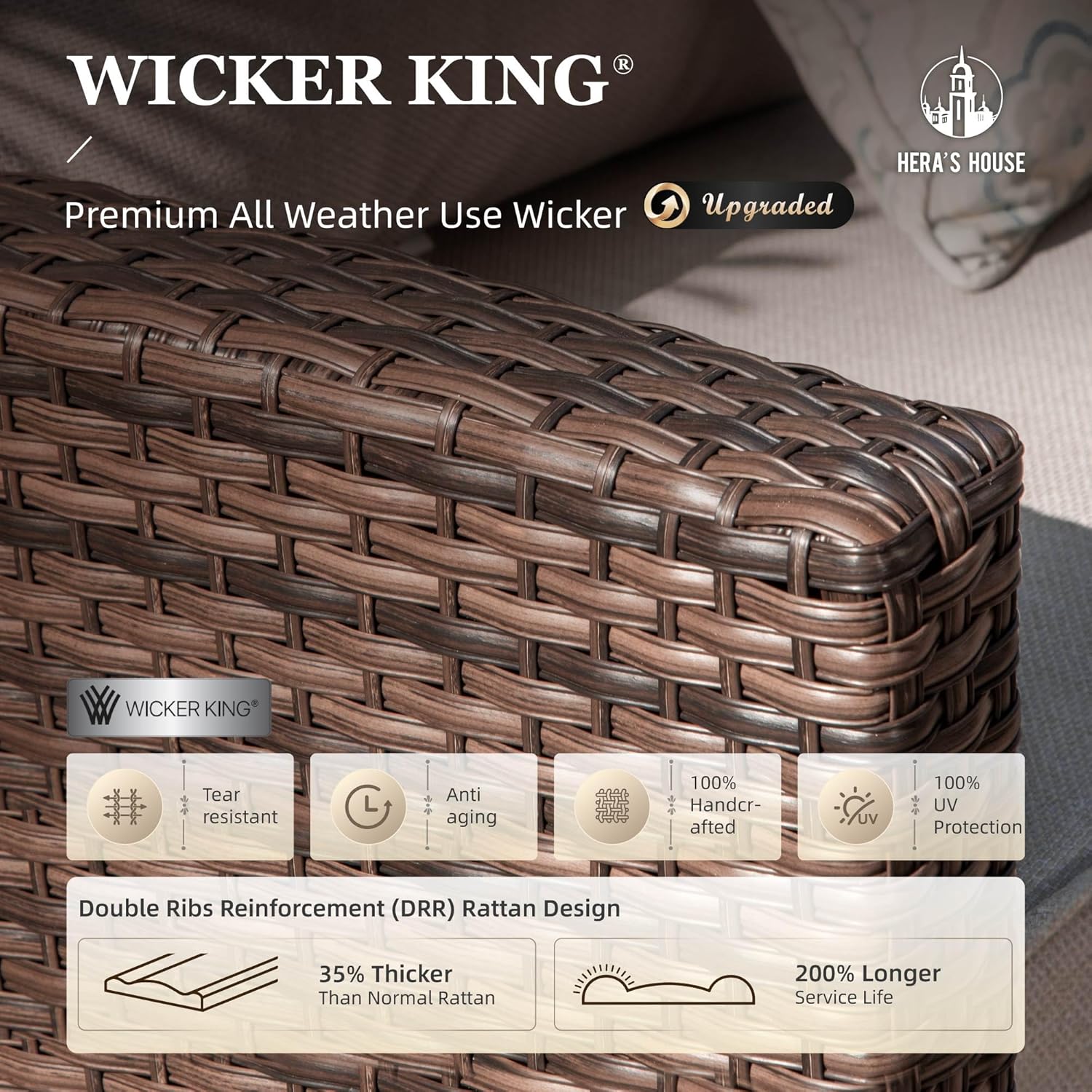
“Wicker” is technically a weaving technique, not a material. Traditional wicker uses natural rattan, seagrass, or willow — beautiful indoors, but it warps, rots, and fades outdoors in a single rainy season. What you see marketed as all-weather wicker or outdoor wicker is almost always resin wicker: thin strands of plastic (polyethylene or PVC) woven by hand or machine over an aluminum or steel frame. The term “resin wicker” just means plastic-woven-to-look-like-wicker, and that category spans an enormous quality range.
Here’s where most buyers get stuck: product listings often use “all-weather resin wicker” as if it were a safety guarantee. It isn’t. Per the This Old House outdoor furniture materials guide, the two variables that actually predict longevity are the type of polyethylene (PE) used and the density of the weave. Everything else — the cushion quality, the frame gauge, the finish — layers on top of those two fundamentals.
The Two PE Grades You’ll Actually Encounter
Almost all outdoor resin wicker sold in the U.S. today uses one of two polyethylene formulations:
HDPE (High-Density Polyethylene): This is the good stuff. HDPE strands are extruded at higher density, which makes them UV-resistant, colorsafe, and structurally stable across a wide temperature range. Manufacturers who use HDPE usually say so explicitly, because it’s a selling point. Wirecutter’s updated patio furniture review (2025) consistently flags HDPE construction as the baseline requirement for any outdoor wicker worth recommending. Owners of HDPE sets in high-UV climates like Arizona and Florida frequently report minimal fading after five-plus years when covered seasonally.
PVC (Polyvinyl Chloride) or low-grade PE: This is what you get in most sub-$500 sets. PVC wicker can look identical to HDPE in photos. The difference shows up in year two or three: cracking along UV-exposed surfaces, color fade that starts at the top of exposed strands, and a brittle texture that can snap under pressure rather than flex. Apartment Therapy’s buying guide on wicker patio furniture notes that the brittleness test — gently flexing a strand with your thumb — is one of the simplest field checks a shopper can do in a showroom. HDPE flexes slightly; cheap PVC or low-grade PE resists and then cracks.
One thing to watch: some manufacturers list “PE wicker” without specifying HDPE. That’s a yellow flag. If the spec sheet doesn’t say HDPE, ask or assume it’s a lower-density formulation.
Weave Quality: The Four Numbers Worth Checking
Once you’ve confirmed HDPE, the weave itself determines how the set looks and holds up structurally. Most serious buyers skip this, because weave specs aren’t always advertised. But they’re often visible in product photography if you know what to look for — and some brands publish them.
1. Strand width: Premium outdoor wicker typically uses strands between 4mm and 6mm wide. Thinner strands (under 3.5mm) create a more delicate aesthetic but are more prone to snagging and breakage. Wider strands (over 7mm) can look bulky and may signal a lower-cost extrusion process.
2. Weave density (strands per linear inch): Higher density means fewer visible gaps, more surface coverage over the frame, and a finished product that feels solid rather than skeletal. A well-built set typically shows 4–6 strands per inch in a close inspection. Budget sets often run 2–3 strands per inch, which creates a gappy look that also lets UV radiation degrade the frame beneath.
3. Hand-woven vs. machine-woven: Hand-woven sets are tighter, more consistent, and easier to repair if a strand breaks — you can re-weave a section. Machine-woven sets are uniform but harder to repair because the interlocking pattern is more complex. House Beautiful’s outdoor furniture buying guide notes that most sets in the $800–$2,000 range are hand-woven over aluminum frames; below that, expect machine weaving.
4. Frame gauge beneath the weave: The wicker is only as stable as the frame it sits on. Look for aluminum frames with wall thickness of at least 1.2mm (sometimes listed as “heavy gauge aluminum”). Thinner frames flex, and flex eventually cracks wicker strands at attachment points — usually at armrest joins and seat corners first.
By the Numbers
| Price tier | Typical resin type | Avg. strand width | Weave method | Expected lifespan (covered, seasonal) |
|---|---|---|---|---|
| $300–$550 | PVC or unspecified PE | 2–3.5mm | Machine | 3–5 years |
| $600–$1,000 | PE (sometimes HDPE) | 4–5mm | Machine or hand | 5–8 years |
| $1,100–$2,000+ | HDPE | 4–6mm | Hand-woven | 8–12+ years |
Sources: aggregated spec data from manufacturer listings, Wirecutter patio furniture review (2025), Architectural Digest outdoor conversation set roundup.
Frame Material: Aluminum vs. Steel and Why It Matters More Than You Think
Resin wicker looks the same regardless of what’s underneath — until it doesn’t. Frames rust from the inside out, and you won’t see evidence of it until the wicker starts pulling away from corroded connection points.
Aluminum frames are the correct choice for outdoor wicker. Aluminum doesn’t rust (it oxidizes, but that oxidation is superficial), it’s lightweight enough to move around a deck, and it doesn’t add thermal stress to attached wicker strands during temperature swings. Per Architectural Digest’s roundup of outdoor conversation sets, virtually every set they recommend above $800 uses a powder-coated aluminum frame. Powder coating — a factory-applied electrostatically bonded paint process — is more chip-resistant than spray paint and adds a meaningful corrosion barrier. Look for multi-stage powder coating (the spec sheet or listing may say “3-stage” or “5-stage”) as a marker of a more serious manufacturing process.
Steel frames aren’t automatically bad, but they require more maintenance scrutiny. Galvanized steel can hold up well, but if the galvanization is thin and the powder coat chips (common on cheaper sets), surface rust appears within one to two seasons. Owners in coastal climates report this failure mode frequently in aggregated reviews. If a set you’re evaluating uses steel, check whether it’s galvanized and whether the manufacturer specifies salt-air resistance.
Climate Matching: Which Resin Spec for Your Region
Generic “all-weather” claims don’t account for the actual stresses your climate puts on resin wicker. Here’s how to match spec to environment:
High UV / arid (Southwest, Southern California): UV degradation is your primary enemy. Prioritize HDPE with documented UV inhibitors in the formulation — some brands specify this as “UV-stabilized HDPE.” Color matters here too: lighter colors tend to fade less visibly, but the structural degradation is the same. Owners in Phoenix and Las Vegas consistently report that even quality sets need seasonal covers to hit their rated lifespan.
High humidity / subtropical (Gulf Coast, Florida, Southeast): Moisture intrusion at frame connection points is the main failure mode. Look for sealed frame ends (manufacturers sometimes call these “capped” or “sealed” frame ends) to prevent water from entering hollow aluminum sections and pooling. Mildew-resistant cushion fabric (Sunbrella or equivalent solution-dyed acrylic — meaning the color runs through the fiber, not just the surface — is the standard benchmark per Sunbrella’s own product specifications) matters almost as much as the wicker itself in these climates.
Freeze-thaw cycles (Midwest, Northeast, Mountain West): Thermal expansion and contraction stress wicker-to-frame attachment points. Sets stored outdoors year-round in these climates degrade faster regardless of resin quality. If you’re not covering or storing your set through winter, budget for a two-to-three-year shorter lifespan than the manufacturer’s rated estimate, and prioritize sets with hand-woven construction (easier to re-weave loosened sections).
Coastal / salt air: Salt accelerates metal corrosion and can degrade lower-grade resin surfaces. HDPE is your minimum here; aluminum frames are non-negotiable. Gardenista’s outdoor furniture guides for coastal homes consistently flag powder-coated aluminum plus HDPE as the only combination worth the investment in salt-air environments.
The True Five-Year Cost of a Wicker Conversation Set
The sticker price is almost never the real cost. Here’s what a realistic five-year ownership math looks like for two common tiers:
Entry set ($450 sticker, PVC/machine-woven):
- Year 1–2: No notable issues
- Year 3: Cushion replacement likely ($80–$150 for a 4-piece set)
- Year 4: Visible strand fading and brittleness begin
- Year 5: Set is functionally at end-of-life; replacement purchase
Five-year total: $450 (set) + $120 (cushions) + $450 (replacement set) = ~$1,020
Mid-tier set ($1,100 sticker, HDPE/hand-woven/aluminum frame):
- Year 1–3: No notable issues with seasonal cover ($40–$60)
- Year 4: Cushion refresh possible but not required ($80–$150)
- Year 5: Set in good condition, likely good for another 4–6 years
Five-year total: $1,100 (set) + $50 (cover) + $120 (cushion refresh) = ~$1,270
The premium set costs roughly 25% more over five years — and you’re not done paying for the budget set yet. This is the math that Wirecutter’s outdoor furniture team consistently makes in their cost-of-ownership analysis, and it’s the core reason their recommendations skew toward HDPE sets even when budget options are available.
If X, Then Y: Your Decision Rule
You’ve done the research. Here’s how to land:
If you’re furnishing a rental property or a seasonal-use space where durability is secondary to minimizing upfront capital: A well-reviewed machine-woven PE set in the $400–$600 range is a defensible choice. Just budget for cushion replacement in year 3 and frame replacement in year 5–6. Don’t overspend here.
If this is your primary outdoor living space and you entertain regularly: Don’t go below HDPE and hand-woven construction. The $900–$1,400 range is where the quality-to-price curve inflects. Prioritize sealed aluminum frames, documented UV-stabilized HDPE, and a Sunbrella or solution-dyed acrylic cushion package.
If you’re in a coastal or extreme-UV climate: The $1,200+ tier isn’t a luxury — it’s a climate tax. Sets marketed specifically for coastal use (brands will often flag this in their product titles or spec sheets) typically include additional UV inhibitors and sealed frame ends that justify the premium. Owners in these environments who went cheaper consistently report regret in aggregated reviews across major outdoor furniture retailer platforms.
If a listing doesn’t specify HDPE, doesn’t list frame wall thickness, and doesn’t mention powder-coat stages: Assume the worst on all three. Quality manufacturers advertise these specs because they’re selling points. Omission is the spec sheet’s version of a red flag.
The wicker conversation set category rewards research more than almost any other patio furniture type, because the quality differential is nearly invisible at point of purchase. The buyers who don’t buy twice are almost always the ones who slowed down long enough to read the spec sheet.